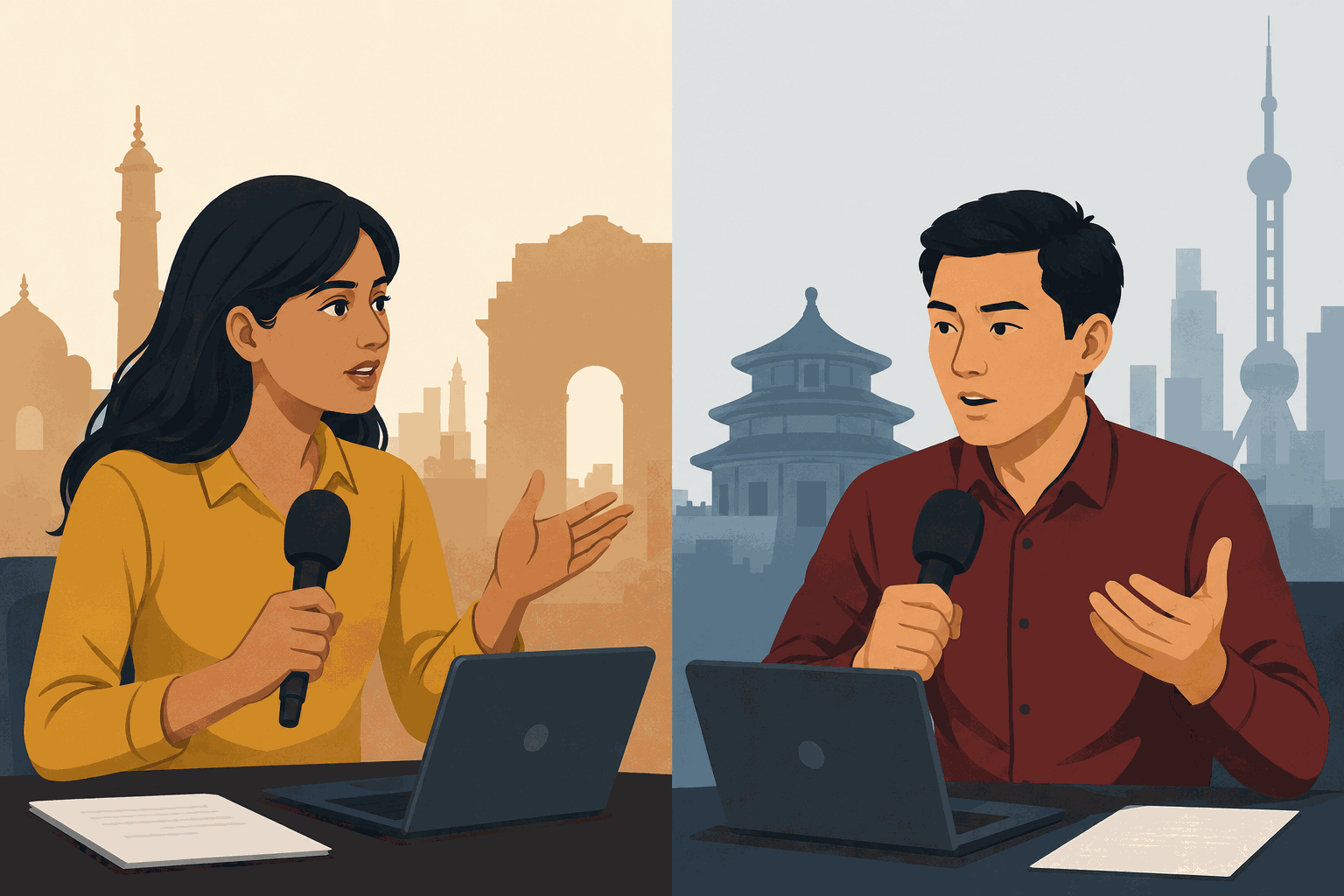
The media, composed of journalists and broadcasters, have an important role to play in any state; informing public discourse, providing entertainment services and educating audiences on a variety of issues. As two major Asian powers with distinct political systems, India and China are home to substantially different media ecosystems. China's media system is subject to Party-state oversight and is expected to support political and developmental objectives. India's media landscape is characterized by a competitive environment comprising public broadcasters, private television networks, newspapers, digital platforms, and independent journalists. Despite the differences, media coverage in India and China has often served as an important intermediary through which citizens, policymakers, and business communities understand developments in the neighboring country.
Journalists and broadcasters from both India and China have contributed significantly to bilateral perceptions and expanded the worldviews of their respective audiences. As knowledge brokers and informal intermediaries, media representatives like resident correspondents, radio jockeys and even content creators, provide direct observations from the other country, shaping public opinion, elite discourse and academic outlooks. The trajectory of media relations in the context of India and China’s contemporary ties offers a telling view of the way both people in both nations have been able to understand each other.
Initial Waves
The earliest sustained Chinese journalistic presence in India came through the overseas expansion of the state news agency, Xinhua News Agency. Xinhua began building a global network of resident correspondents in the 1950s, establishing overseas bureaus as part of China's international communication strategy. Xinhua's New Delhi bureau became one of its earliest South Asian reporting hubs. Prior to an established presence in India, Chinese newspapers like Renmin Ribao reported occasionally on the activities of the China India Friendship Association, while reportage of China in India was largely conducted through diplomatic reporting, foreign agency dispatches and occasional visits.
Before newspapers and media platforms expanded their coverage with on-ground reportage, radio was the first medium to establish connections between the two countries. China’s Hindi-language radio broadcast through China Radio International (CRI) began in 1959, and its Tamil language service was established in 1963. Today, it broadcasts in multiple Indian languages like Hindi, Bengali, Tamil and Urdu, with Chinese presenters fluent in Indian languages. Shayma Ballabh became CRI’s first Hindi-language announcer, and her family continues to recall her historic contribution as a cultural intermediary in China.
Emerging from Isolation
The reportage of India and China after the 1962 war became securitized, with news presented through the prism of the border dispute or military developments. India and China occupied a relatively small place in the reportage of media platforms during the 1970s and 1980s, given the isolation of China before the reform and opening up period. Following the opening up of China and its economic reforms, curiosity drove Indian reporters to visit China and document its economic zones, growing industry and other emerging trends. For many Indian readers, these reports were the first detailed glimpse of post-Mao China. The growing coverage of China was also accelerated by Indian PM Rajiv Gandhi’s visit to China in 1988, the first visit to the country by an Indian Prime Minister since 1954.
In China, reportage by the People’s Daily emphasized cooperation over conflict as bilateral relations focused on pragmatic diplomacy and reconciliation. India’s economic liberalization in the early 1990s was covered extensively by Chinese journalists of Xinhua and People’s Daily. In the following years, they discussed India’s democratic setup, the software boom of the 2000s and an information technology revolution that would shape economic growth outcomes in India. India’s nuclear tests of 1998 also generated significant Chinese coverage of regional stability, India’s security considerations and balance of power across the Himalayas. The end of the 1990s also brought an end to reliance on wire services, and saw media organisations rely on resident correspondents who could cover local stories, social dynamics and present pictures of everyday life.
New Millenium, New Media
The 2000s and subsequent decades saw journalists stationed in China play an outsized role in shaping bilateral perceptions. Indian correspondents based in Beijing, including reporters from leading daily newspapers like The Hindu, The Indian Express, Hindustan Times and other outlets, have provided valuable first-hand reporting on Chinese politics, economic reforms, technological development, and social change. Their reporting challenged simplistic portrayals of China by highlighting the complexity of Chinese governance, society, and regional development. Reporters like Pallavi Aiyar and Ananth Krishnan have been influential in shaping cross-cultural perception and public attitudes. Similarly, Chinese correspondents stationed in India have sought to explain India's democratic politics, economic transformation, and social diversity to Chinese audiences. Chinese journalists working for Xinhua News, and others from China Central Television (CCTV), have covered developments in India from various parts of the country. Wang Zichen, a former reporter at China's state-owned news agency Xinhua, told the Wall Street Journal that "The presence of more journalists from China in India would help to bridge the gap between the two countries and foster a deeper understanding of each other’s cultures and perspectives." The former Beijing correspondent for The Indian Express, Sowmiya Ashok, emphasizes the same point about having journalists present in both countries, stating that "having boots on the ground...feeds into both public perception and effective diplomacy."
The contributions of Indian and Chinese journalists enabled greater cultural understanding of audiences in both countries. However, the nature of bilateral relations between India and China, shaped by border disputes and political frictions, impacted the media narratives and operations on both sides of the Himalayas. The Doklam and Galwan clashes in 2017 and 2020 created a difficult environment for media operations and spotlighted the activities of Chinese journalists in India and vice versa. It eventually led to the expulsion of three Xinhua journalists, Wu Qiang, Lu Tang and She Yonggang based in Delhi and Mumbai in 2018. Indian journalists too came under the scanner for their connections to Chinese nationals, like freelance journalist Rajeev Sharma, who was arrested in 2020 for passing sensitive information to Chinese intelligence, according to the Delhi police. A scheduled to visit to Tibet by Indian journalists was also cancelled by China in 2017, on the heels of the Doklam skirmish that saw armed formed from both side clash in Sikkim.
As bilateral relations went from bad to worse, media relations deteriorated with it. By 2023, India and China were restricting each other’s journalists by denying them visa extensions or freezing existing visas. Hu Xioming, the New Delhi bureau chief for Xinhua since 2017 described the situation as “torment” of Chinese reporters, and China’s Foreign Ministry made a statement on the status of Chinese media workers in India. The removal of Chinese journalists from India marked the first instance of no Chinese journalists in the country since the normalisation of India-China ties in the 1980s. Indian journalists in China too faced a similar situation, with the last Indian journalist in Beijing asked to leave the country on 12 June 2023. This brought the number of Indian journalists working in China down from four, to zero.
The Thaw
Media contacts resumed cautiously after the diplomatic thaw that followed the October 2024 agreement on disengagement at key friction points along the Line of Actual Control. Subsequent high-level meetings between Indian and Chinese leaders and officials created momentum for the restoration of broader exchanges. In January 2025, both governments agreed to facilitate journalist exchanges as part of efforts to stabilize relations and rebuild channels of communication that had collapsed after 2020. For instance, the Chinese government invited a group of Indian journalists in June 2025 to cover the first two batches of the Kailsash Mansarovar pilgrimage, which was suspended due to the COVID-19 pandemic in 2020. While the return of resident correspondents has been gradual and subject to regulatory scrutiny, the decision to allow journalists to return to their posts marked an acknowledgment by both sides that journalists remain an important bridge for mutual understanding and public diplomacy.
.jpg)