Cinema is one of the most influential vehicles of cultural exchange. More than entertainment, films communicate social values, everyday life, aspirations, family dynamics and national identities. For countries such as India and China, popular cinema has become an important lens through which each society imagines and understands other communities and cultures.
Bollywood, in particular, has played a significant role in shaping Chinese perceptions of India. Across different periods, Indian films have introduced Chinese audiences to India's social fabric, traditions, music, family relationships and contemporary challenges, while also generating emotional connections that transcend political narratives.
Classical Connection
Awaara was one of the first Indian films that was showcased in China. Its release in 1979 has left an enduring impression on older Chinese generations, and was followed by Caravan in the 1980s, a romantic drama that deepened India’s image in China. Subsequent releases in China like Noorie were widely screened, made possible by China's opening-up in 1978 which allowed more foreign films in the country.
The 1982 film, Disco Dancer was cult hit in China, establishing Indian cinema’s cultural resonance with Chinese audiences. The early releases in the 70s and 80s created the foundations for contemporary Bollywood films to gain further popularity in China. Although classical Indian cinema was beginning to form strong cultural impressions in China, their success was short-lived. Chinese restrictions on foreign films in the following years led to a decrease in the number of Indian films watched by the Chinese.
Bollywood’s New Foray
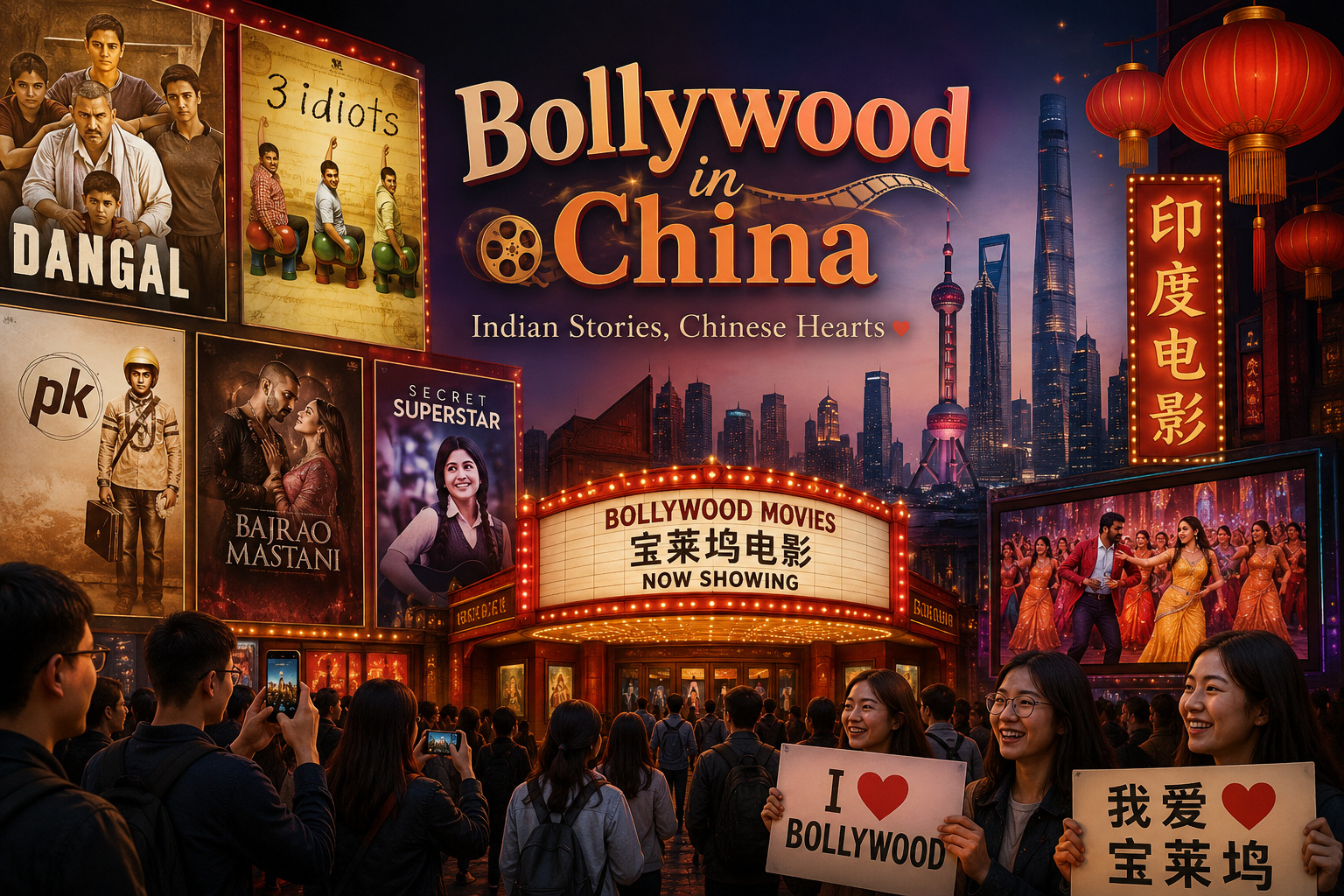
Indian cinema experienced a remarkable resurgence in China from the late 2000s onwards. Driven by changing audience preferences, the expansion of China's film market and the emergence of films centred on universal themes such as family, education, gender equality and social mobility, Bollywood found a new and much larger audience. Unlike the earlier era, where Indian films were remembered primarily as cultural curiosities, contemporary Bollywood became a commercially viable and popularly-accepted presence in China. This renewed popularity not only transformed Indian cinema into one of the most recognizable foreign film industries in China, but also cemented its role as an important channel of people-to-people engagement and cultural understanding. The extent of Chinese audience’s interest in Indian films was reflected in the fact that the pirated version of the film 3 Idiots was popular, even though the film was not showcased in China until 2011.
By 2019, Indian films had earned more than US$2.5 billion in cumulative box office revenue from the Chinese market, highlighting the commercial potential of cultural exports. Although China remains one of the world's most challenging film markets, its place as the second-largest box office market after the United States attests to its significance. Moreover, foreign releases are controlled through quotas that permit only around 34 foreign films to be released each year. Despite these constraints, several Bollywood films have achieved remarkable commercial success in China. Bajrangi Bhaijaan grossed approximately US$46.6 million, Dangal earned nearly US$197 million, Secret Superstar collected US$124.4 million, and Andhadhun generated almost US$48 million at the Chinese box office. These successes demonstrate Bollywood's growing appeal in China and underscore its role as a powerful instrument of India's cultural diplomacy.

Source: https://www.endata.com.cn/BoxOffice/MovieStock/movies.html
Given the role of star-power in Bollywood and the centrality of “stars” to Indian cinema, Aamir Khan is the most popular Bollywood actor in China. His film Dangal became the highest-grossing film, of all Indian releases in China. Furthermore, his film Secret Superstar is a story about a young girl living in a household with domestic violence but wanting to be a singer, was a great hit in China as well because it resonated with the struggles and lives of Chinese audiences. Amir Khan’s star power was so strong that the Chinese President Xi Jinping told Indian Prime Minister Narendra Modi in 2017, that “he loved” Khan’s movies a lot. Amir Khan is popularly known as “Mi Shu”, which means “Uncle Mi”.
Bollywood's appeal in China can also be seen as transitioning from interest in conventional romances to content-driven storytelling. This change is driven by the awareness of social issues in both India and China. Indian movies which have universal themes, cultural richness and the ability to address social issues like gender equality and education, derive their appeal from these attributes. Moreover, the humor and the happy endings of Indian movies add to the charm of Bollywood movies.

Source: Douban
The cultural chord struck by Indian films in China is reflected in the fact that the movie Secret Superstar crossed $100 million in China, leading the box office and surpassing domestic films in China. Furthermore, the movie also surpassed Hollywood blockbusters like “ Star Wars: The Last Jedi” in terms of ticket sales and revenues. It also secured the first revenue-sharing agreement in China, marking a significant milestone for Indian cinema in China. It recorded over $6 million in ticket presales and a high rating on movie-rating websites like Douban. The emotional impact of the movie was evident even during a preview screening, where audiences alternately laughed and wept. The film's success is attributed to its old-fashioned tale of an underdog and the presence of Aamir Khan. The theme of struggle against a patriarchal society resonated with many Chinese viewers because it addressed social issues relevant to China. Additionally, the arrangement between China and India to coproduce movies has also created positive perceptions between the two countries.
Another Indian movie that won the hearts of the Chinese audience, was Dangal. Despite being a Hindi language drama which focused on wrestling, the film resonated with the Chinese audience and grossed $190 million. Themes of hard work, women's empowerment and family sacrifice engaged Chinese and Indian audiences. It aligned with Chinese cultural virtues and challenged gender norms, resulting in remarkable cross-cultural appeal. The film revealed the similarities and differences between Chinese and Indian cultural values, and thus served as a bridge that connected the hearts of viewers from both nations. The film exemplified the potential of cinema as a medium of cross-cultural exchange and mutual appreciation. Importantly, Aamir Khans' ability to connect with Chinese audiences on a personal level made him an ambassador of cultural exchange between India and China. Dangal acted as a bridge of understanding between India and China and achieved a staggering box office revenue of over 1.3 billion yuan.
The success of films such as Secret Superstar and Dangal demonstrates that Bollywood's influence in China extends well beyond commercial achievement. By presenting relatable stories, Indian cinema has fostered empathy and challenged preconceived notions about India among Chinese audiences. In doing so, Bollywood has emerged as one of the most effective instruments of cultural diplomacy, illustrating how popular culture can create meaningful people-to-people connections even during periods of political uncertainty and strained bilateral relations.
Conclusion
Indian cinema has become one of the most significant channels of cultural engagement between India and China, shaping perceptions in ways that formal diplomacy often cannot. By portraying India's social realities, traditions, values, and aspirations through compelling narratives, Bollywood has helped foster greater familiarity and empathy among Chinese audiences while challenging stereotypes and misconceptions. Although cultural exchange cannot resolve broader geopolitical differences, the enduring popularity of Indian films demonstrates the capacity of popular culture to strengthen people-to-people ties, influence public attitudes and complement diplomatic engagement. Bollywood remains a valuable instrument of India's soft power and an important medium for transmitting cultural understanding between the world's two most populous nations.