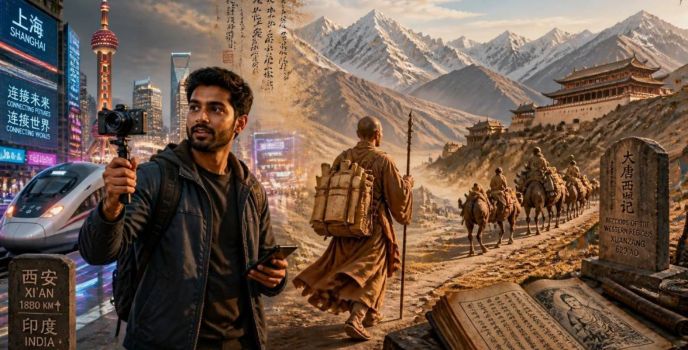
Long before travel became something recorded on phones, uploaded online and shared with audiences thousands of kilometres away, travellers have shaped how distant societies understood one another. Today, an Indian traveller can walk through the streets of a Chinese city, film a university dormitory, board a train or sit down for a meal, and offer thousands of viewers a glimpse of a society they may never visit themselves. For many watching from afar, such encounters can complicate assumptions built through news, popular culture and political narratives. The traveller becomes a pair of borrowed eyes.
More than a thousand years ago, the journey itself looked very different. There were no cameras, airports or direct flights. Travellers crossed mountains, deserts and seas, often spending years away from home. Chinese Buddhist monks made this journey, travelling to India in search of sacred texts, teachers and religious knowledge. What they encountered along the way would eventually become part of some of the earliest and most detailed Chinese accounts of the Indian subcontinent.
For centuries, India occupied a powerful place in the cultural imagination of China. It was the land of the Buddha, the source of sacred texts and the home of monasteries and teachers whose words had travelled east long before many Chinese pilgrims themselves could. Yet the India they knew was also distant, encountered through translated scriptures, travelling monks and stories carried across the vast spaces between the two civilisations.
Map of Faxian’s Journey taken from "Travels of Fah-Hian and Sung-Yun", Buddhist pilgrims, from China to India (400 A.D. and 518 A.D.)

Far from the stereotypical depiction of foreign lands, India was as a sophisticated, civilized land, and a deviation from the norm. Through the writings of pilgrims such as Faxian, Xuanzang, Yijing and others, China encountered India not merely as an abstract sacred geography but as a living world of cities, kingdoms, monasteries, merchants and ordinary people. Their records remain among the most important windows into the societies of South and Central Asia in the first millennium.
Faxian: The Search for Sacred Texts
More than a millennium before commercial aviation connected Asia, Faxian set out from China in search of Buddhist scriptures and sacred knowledge. His journey eventually brought him across Central Asia and into the Indian subcontinent, where he travelled through Buddhist sites and monastic centres. But perhaps the most dramatic part of his journey came at its end. Around the beginning of the fifth century, Faxian left the eastern Indian port of Tamralipti aboard a merchant vessel bound for Sri Lanka. After spending time on the island, he continued his journey by sea towards Southeast Asia and eventually returned to China.
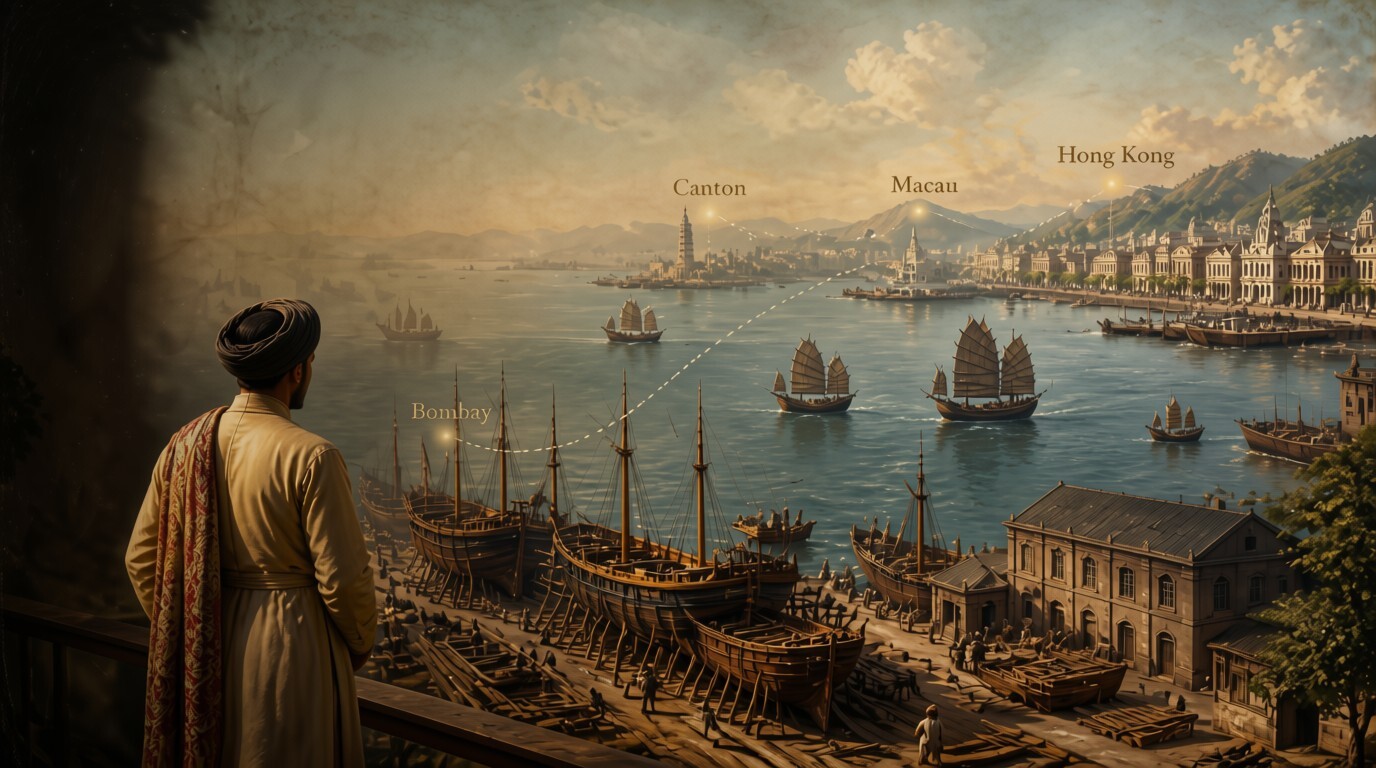
The sea was not a neutral space between civilisations. It was unpredictable, dangerous and, for travellers such as Faxian, dependent on the knowledge and networks of merchants. His voyage reveals an important but often overlooked dimension of early India-China exchanges; pilgrimage and commerce frequently travelled along the same routes. Buddhist monks relied on ships, traders and commercial networks to move across Asia, while the same maritime world carried goods, languages, ideas and religious traditions between distant ports.
The Return of Fa Hsien, illustration from 'Hutchinsons History of the Nations' by Henry Charles Seppings Wright.

Despite being 77 years old, Faxian persevered and finally reached the Chinese coast. His work, 'A Record of the Buddhist Kingdoms,' was an unprecedented firsthand account of Buddhist practices and pilgrimage sites across South and Central Asia, written in Chinese. This account resonated deeply with the Chinese clergy, who revered India as a holy land. One monk, Daozheng, was so profoundly moved by the Indian Buddhist sites and monasteries that he chose to stay behind, expressing a fervent desire to avoid rebirth in the 'borderland’.
Xuanzang: A Road Through Many Kingdoms
If Faxian was among the first great Chinese pilgrims to describe India from personal experience, Xuanzang became perhaps the most famous. Born around 600 CE, Xuanzang marked his prominence in the annals of ancient China as a fervent promoter of Buddhist doctrines and a diplomat facilitating exchanges between India and China. His path-breaking journey to India began in 627 without formal authorization from the Tang court, motivated by a deep desire to visit sacred Buddhist sites and a dissatisfaction with Chinese-translated Indian Buddhist texts. His writings, "The Records of the Western Regions Visited During the Great Tang Dynasty," were not only a testament to his spiritual journey but also a diplomatic archive detailing the socio-political landscapes of foreign states neighbouring Tang China.
A page from Xuanzang's Da Tang Xiyu Ji (The Great Tang Records on the Western Regions), preserved in an edition of the Qing dynasty's Siku Quanshu.

His journey eventually brought him to India, where he spent years studying Buddhist philosophy and travelling across the subcontinent. At Nalanda, one of the great centres of Buddhist learning, Xuanzang immersed himself in intellectual traditions that had previously reached China only through translations and intermediaries. His encounters with foreign rulers during his travels were strategically aimed at securing support for his unapproved journey and eventual return to China. His interactions with King Harsavardhana of India are particularly notable, leading to the establishment of diplomatic relations between India and China, a contribution acknowledged by Tang dynasty scribes.
Xuanzang Returning from India. Eighth-century mural from Cave 103, Mogao Caves, Dunhuang, dating to the High Tang period (712–765 CE). The mural depicts the celebrated Buddhist pilgrim's return journey from India

Xuanzang's writings provide a comprehensive overview of India, from its geography and climate to its social, cultural, and economic norms. His narrative also reflects the "borderland complex" among Chinese clergy, evident in his dialogues with Indian monks at Nalanda Monastery, highlighting the Indian perception of China. His meticulous records of Buddhist sites like Bamiyan and Nalanda remain invaluable resources for historians, archaeologists, and researchers interested in studying premodern cross-cultural interactions.
Statue of Xuanzang near the Giant Wild Goose Pagoda in Xi'an, China.
Source: https://commons.wikimedia.org/wiki/File%3AXuanzang_statue.jpg
Yijing: A Different Road to India
By the time Yijing began his journey in 671 CE, travel between China and India was no longer unimaginable. Stories had demonstrated that the journey was possible, even if it remained dangerous. Networks of merchants, ports and Buddhist communities had also made movement across the Indian Ocean increasingly important to pilgrims.
Yijing’s work, although less renowned than those of Faxian and Xuanzang, are of considerable significance. His journey took him through Southeast Asia before he travelled onwards to India. Like Xuanzang, he was concerned with the correct understanding and transmission of Buddhist teachings. The records he left behind provide intricate details about monastic practices in Indian monasteries, intended to address misunderstandings of Buddhist principles in China. They also document the journeys of dozens of Chinese monks in search of Buddhist learning, revealing that Faxian and Xuanzang were not isolated adventurers. Rather, they were part of a wider community of pilgrims for whom the road to India had become an intellectual and spiritual undertaking shared across generations.
Huichao and the World in Between
Known in Korean as Hyecho and in Chinese as Huichao, he was a young Buddhist monk from the Silla kingdom on the Korean peninsula who travelled through the wider Buddhist world in the eighth century. His travels unfolded during a chaotic period with wars involving the Tang Dynasty, Turks, Sogdians, Tubo, Tocharian, Persian, and Arab groups. Huichao journeyed from Luoyang to Jingzhou, then to Guangzhou, and finally by ship to the Indian subcontinent. In India, he visited significant Buddhist sites like the Mahabodhi Temple.
Huichao's writings, driven by his emotional excitement, idealized India and Buddhism, depicting the king as a reincarnation of Buddha and India as a utopian society. However, he also noted the decline of Buddhism in India, observing deserted temples and societal issues like wealth disparity and the caste system. Despite these observations, he acknowledged the prosperity of Buddhist communities outside India. Huichao's accounts provide valuable insights into the historical context and challenges faced by Buddhism during his time.
From Travelogues to YouTube
In recent years, a number of Indian content creators and travellers have documented their experiences of China, offering audiences glimpses of a country that many may otherwise encounter primarily through news coverage and geopolitical debates. Indian travel vlogger Ansh Mishra, for instance, has documented his travels through China for his online audience, while Indian residents and creators have increasingly used YouTube to share their experiences of everyday life in Chinese cities.
What is particularly striking about this form of travel storytelling is its attention to the ordinary. The focus is often not on a great ruler, a sacred site or a monumental event, but on the routines of everyday life: commuting, shopping, eating, studying and navigating unfamiliar social customs. For an audience watching from India, these small encounters can sometimes be as revealing as the grander images of China that dominate public discussion.
Thumbnail of Travel Videos Made by Indian Traveller in China

Source: https://www.youtube.com/playlist?list=PLaAdJCcdcj7AldY79iVJ1U4QTsM2bVpyE
The medium, of course, has changed dramatically. Faxian and Xuanzang returned with manuscripts and memories that would later be transformed into travel records. Today's traveller carries a camera and can narrate the journey while still making it. The audience is no longer limited to a court, monastery or community of scholars; it can include anyone with access to a screen.
Yet the contemporary traveller also faces a challenge familiar to those who travelled centuries ago. No journey produces a complete picture of another society. What a traveller records is shaped by where they go, whom they meet and what they consider worth noticing. A YouTube video, like an ancient travelogue, is therefore both an account of a place and a reflection of the person who encountered it.
The Journey Between Civilisations
Centuries later, the tools through which travellers tell their stories have changed, but the act of travelling and recording, of attempting to make sense of another society, continues to play a pivotal role in how people imagine worlds beyond their own.
The history of India and China, therefore, has also been shaped by those who crossed the distance between the two societies, including monks searching for sacred knowledge, merchants moving between ports, students living abroad and travellers recording what they encounter.
And while the journeys may no longer take years, or the roads may have become railways and the manuscripts into cameras; the impulse has nevertheless remained much of the same: to leave the familiar behind, encounter another world and return with a story to tell.