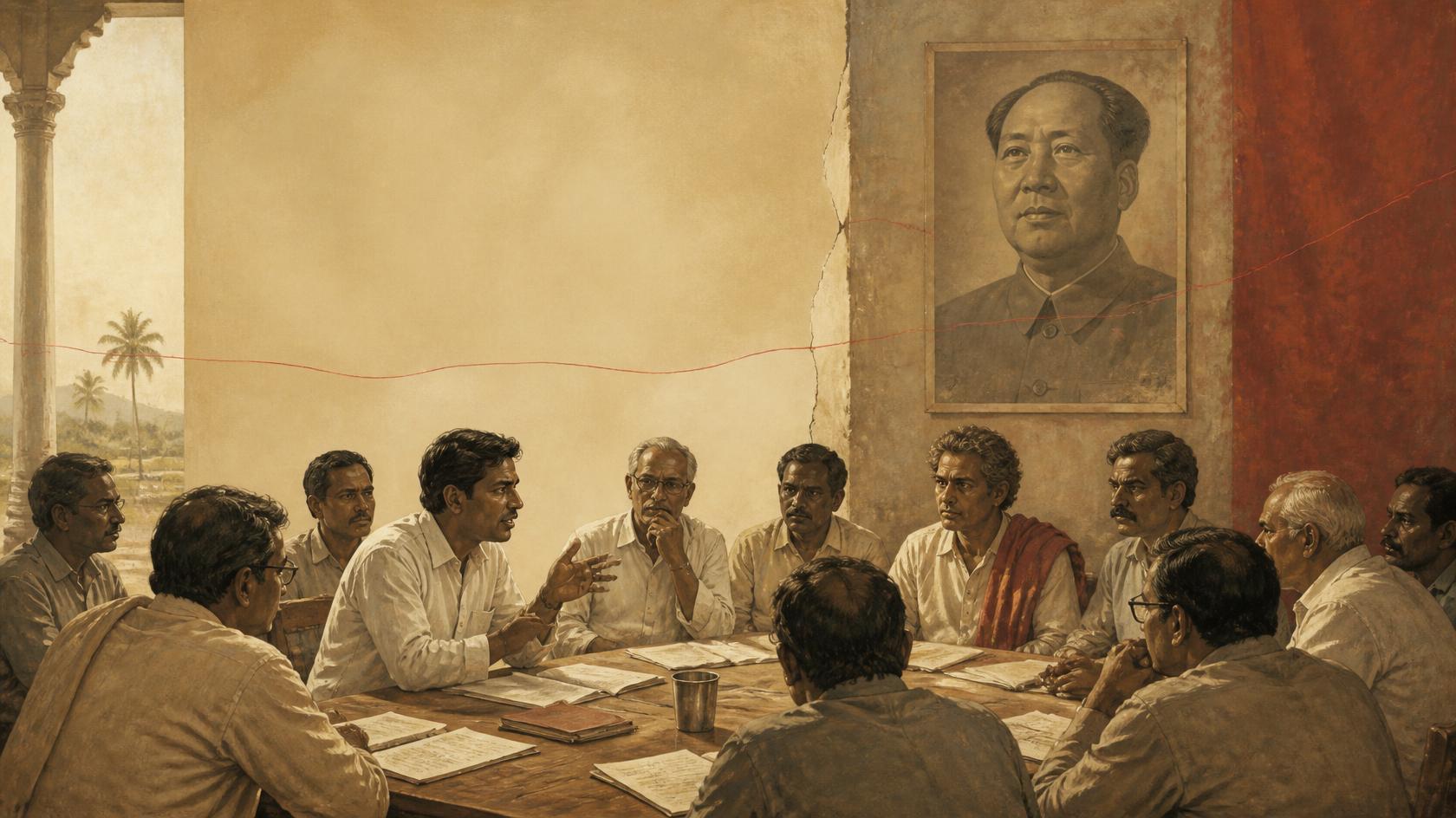
The year is 1964. Over a hundred people are gathered in Tenali, Andhra Pradesh. Proposals are being discussed, arguments are becoming increasingly sharp, and the divisions within India's communist movement are moving towards a formal break. Look past the people in the room, however, and there is another detail that captures the politics of the moment. A large portrait of Mao Zedong hangs in the room.
The Tenali Convention, held from 7 to 11 July 1964, brought together 146 delegates claiming to represent around 100,000 members of the Communist Party of India (CPI). It was a major step towards the formation of what would become the Communist Party of India (Marxist), or CPI(M), later that year. The CPI(M)'s own historical account describes the split as the culmination of a prolonged struggle within the Indian communist movement over questions including class struggle and the character of India's revolutionary path.
China had entered the intellectual world of Indian communism well before the CPI(M) was formed. The Chinese Revolution of 1949 was welcomed by the CPI as an important development, although the Soviet Union remained its principal ideological reference point. The CPI regarded the Chinese Revolution as “epoch-making” but continued to look to the Soviet Union for doctrinal and tactical guidance.
Mao, meanwhile, was already looking towards India. In his first message to the Indian Communist Party after the establishment of the People's Republic of China, Mao told B.T. Ranadive that the histories and future paths of India and China were similar in several respects.
Communism and the Agrarian Question in Asia
The Chinese experience also offered Indian communists a different revolutionary model. China had transformed an overwhelmingly agrarian society through a prolonged struggle built around the countryside and peasant mobilisation. This mattered in India, where the question of how Marxism could be applied to a largely rural, agrarian and economically uneven society remained unresolved. The Chinese model consequently became part of the debate over whether India's revolutionary strategy should follow the Soviet experience or develop a distinct path suited to Indian conditions.
The decisive change came during the late 1950s and early 1960s. The Sino-Soviet split divided the international communist movement, with Beijing challenging Moscow's interpretation of Marxism-Leninism and its policy of peaceful coexistence with the West. Within India, this international dispute intersected with an older disagreement over the Congress government and the direction of Indian communism. The Soviet Union's close relationship with New Delhi was particularly uncomfortable for those sections of the CPI that regarded the Congress as a representative of India's bourgeois-landlord order rather than as a potential partner.
The 1962 Sino-Indian War brought these disagreements into the open. The question was no longer simply whether Indian communists preferred Moscow or Beijing. It became a question of how the party understood Indian nationalism, the Congress government and the border conflict itself. The CPI's leadership condemned Chinese aggression and called for national unity in defence of India, while a substantial section of the party's left wing opposed this approach. Several communist leaders were arrested during the conflict. The war did not create the divisions within the CPI, but it made those divisions impossible to contain.
The organisational rupture nonetheless came in 1964. On 11 April, 32 members walked out of a CPI National Council meeting in protest against the party leadership. The dissident group subsequently organised the Tenali Convention, where the divisions within the party were debated and the groundwork was laid for a separate party. The convention also passed a resolution on the India-China border dispute calling for direct negotiations between New Delhi and Beijing. The original Tenali resolution was quite revealing as even while the border dispute remained unresolved, the convention argued that negotiations between India and China were preferable instead of continued confrontation.
The formal creation of the CPI(M) came later in the year at the Calcutta Party Congress. This is important because Tenali represented the consolidation of the dissident left, while the Calcutta Congress formally established the new party. The CPI(M)'s own account of its 1964 Programme stresses that the party's immediate concern was not simply to choose between Moscow and Beijing. It was to develop a political programme that, in its own words, applied Marxism-Leninism to India's specific conditions.
Senior CPI(M) leaders in 1966: A.K. Gopalan, B.T. Ranadive, E.M.S. Namboodiripad and Hare Krishna Konar.
Source: https://commons.wikimedia.org/wiki/File%3ACPI_%28M%29_Leaders._Noormahal._27_Oct_1966.jpg
This is also where the China connection becomes more complicated. The CPI(M) emerged with a stronger ideological affinity towards Beijing than the CPI, but it did not become a Maoist party. The difference became clear within only a few years.
The Naxalbari uprising of 1967, which would become a defining rupture in the history of Indian communism, exposed the limits of the CPI(M)'s China affinity. The Communist Party of China (CPC) hailed the uprising, while radical elements within the CPI(M) increasingly embraced Mao's revolutionary strategy. The slogan “China's Chairman is our chairman”, visible in photographs from the period, captured this emerging ideological current far more clearly than it captured the position of the CPI(M) itself. The CPI(M) leadership rejected the call for immediate armed struggle and refused to adopt Naxalbari as the model for India's revolution. As the differences sharpened, Beijing increasingly supported the Naxalite tendency, while the CPI(M) opposed what it regarded as “left adventurism”. The eventual formation of the CPI(ML) in 1969 therefore turned what had initially been an affinity with the Chinese revolutionary experience into a deeper divide within India's communist movement.
Charu Mazumdar, Kanu Sanyal and Jangal Santhal became the principal faces of the revolutionary current that emerged from Naxalbari.

A contemporary archival document from the period records the CPI (M) seeking mediation in its increasingly strained relationship with Beijing, specifically citing Chinese support for the Naxalbari uprising and criticism of the CPI(M). What followed was therefore not simply a split between a “pro-China” and an “anti-China” Left, but a sharper contest over which lessons, if any, India should draw from Mao's revolution.
Beyond Ideology: Economic and Developmental Engagement
For much of the following period, relations between the CPI(M) and the Communist Party of China remained strained. This changed in the early 1980s, when China itself was undergoing a major transformation under Deng Xiaoping. In April 1983, a three-member CPI(M) delegation led by E.M.S. Namboodiripad, accompanied by M. Basavapunnaiah and Harkishan Singh Surjeet, travelled to China specifically to explore the restoration of party-to-party relations. The visit marked a new phase and the relationship was no longer based on the expectation that one communist party should follow another. Instead, the two sides sought to establish contact on the basis of party independence and mutual respect.
E.M.S. Namboodiripad, CPI(M) general secretary, is greeted by Peng Zhen in Beijing

One of the most controversial moments in the relationship came in 1989. The CPI(M) supported the Chinese government's interpretation of the Tiananmen protests and its military response. The party's Central Committee resolution of July 1989 described the events as an attempt at destabilisation and argued that the Communist Party of China and People's Liberation Army had thwarted it. The resolution is reproduced in later discussions of the party's position, including its 1989 assessment of developments in China.
The episode remains significant because it demonstrates the depth of the ideological connection even after the party had developed an independent political line. The CPI(M)'s position was not simply an endorsement of China's domestic politics; it reflected its interpretation of the events through the broader ideological framework of socialism, imperialism and counter-revolution. The position nevertheless attracted considerable criticism within India, including from sections of the Indian Left.
Nonetheless, the China that the CPI(M) encountered in the 1980s was very different from the China that had inspired the Indian Left in the 1960s. Deng's reforms were beginning to reshape the Chinese economy, and the CPC was attempting to explain how a socialist political system could incorporate markets, foreign investment and economic reform. For the CPI(M), China increasingly became an object of study rather than simply an ideological reference.
This was particularly visible in later party delegations. In 2006, a five-member CPI(M) delegation led by Sitaram Yechury travelled to China at the invitation of the CPC's International Department. The delegation met senior Chinese officials, including Foreign Minister Li Zhaoxing, and discussed both party-to-party relations and India-China relations. The visit took place shortly before Chinese President Hu Jintao's November 2006 visit to India.
The delegation also travelled beyond Beijing. In Tianjin, Yechury examined China's economic transformation and the way the Chinese leadership was approaching the relationship between socialism and economic development. His account in People's Democracy focused on China's attempt to move from what it called the primary stage of socialism towards a more advanced stage of development.
The relationship had by then also acquired a diplomatic dimension. During Hu Jintao's visit to India in November 2006, the Chinese president met Indian Left leaders and explicitly referred to the party-to-party relationship between the CPC and the CPI(M), CPI and Forward Bloc. Hu also argued that India's Left parties could contribute to strengthening political, economic and strategic relations between India and China.
China's economic transformation became an equally important part of the relationship. The CPI(M) increasingly studied China's experience with economic reform, poverty reduction, state-owned enterprises, local governance and the role of the Communist Party. The party's later ideological documents devote considerable space to analysing the Chinese reform process, including the expansion of private enterprise and the changing relationship between the state and the economy. Its 20th Congress resolution on ideological issues describes the changes that followed China's reform process beginning in 1978 and examines them within the wider debate over socialism.
The relationship has continued into the present. In September 2025, CPI(M) General Secretary M.A. Baby led a six-member delegation to China at the invitation of the International Department of the CPC Central Committee. The CPI(M)'s own announcement described the visit as part of continuing “party-to-party exchanges” between the CPI(M) and CPC. The delegation travelled to Beijing as well as other parts of China and met representatives of the CPC.
CPI(M) General Secretary M.A. Baby with Sun Haiyan, Vice-Minister of the CPC Central Committee's International Department, during the CPI(M) delegation's visit to China, September 2025.

Source: https://www.idcpc.org.cn/english2023/lldt/202510/t20251009_167652.html
The significance of this relationship has therefore changed considerably since the portrait of Mao was displayed at Tenali. In 1964, China represented one side of a bitter ideological dispute within the international communist movement. By the 1980s, it had become a party with which the CPI(M) was attempting to rebuild formal relations. By the 2000s, Chinese economic development had become an important subject of study for CPI(M) delegations, while the CPC increasingly viewed the Indian Left as a political channel through which India-China relations could be strengthened.
The history of the CPI(M)'s connection with China is consequently not a straightforward story of ideological allegiance. It began with an attraction to the Chinese revolutionary experience, became entangled with the Sino-Soviet dispute and the 1962 war, and contributed to the political circumstances surrounding the CPI split. Yet the CPI(M) subsequently disagreed sharply with Beijing over Naxalbari and Maoist revolutionary strategy. Relations broke down, were restored in 1980s, and then developed into a more institutionalised exchange between two communist parties.
What has however endured is China's place in the CPI(M)'s political imagination. Mao's revolution, China's experience of agrarian transformation, Deng's economic reforms, the organisation of the CPC and the country's subsequent development have all provided points of reference for India's Marxist Left.