The exchange of languages among civilisations has long been closely tied to the movement of people between societies. Language has often been the means through which those crossing these boundaries understood unfamiliar cultures and conveyed them to others. Across generations, these encounters have left traces in the languages themselves, as words travel beyond their original setting and acquire new meanings along the way.
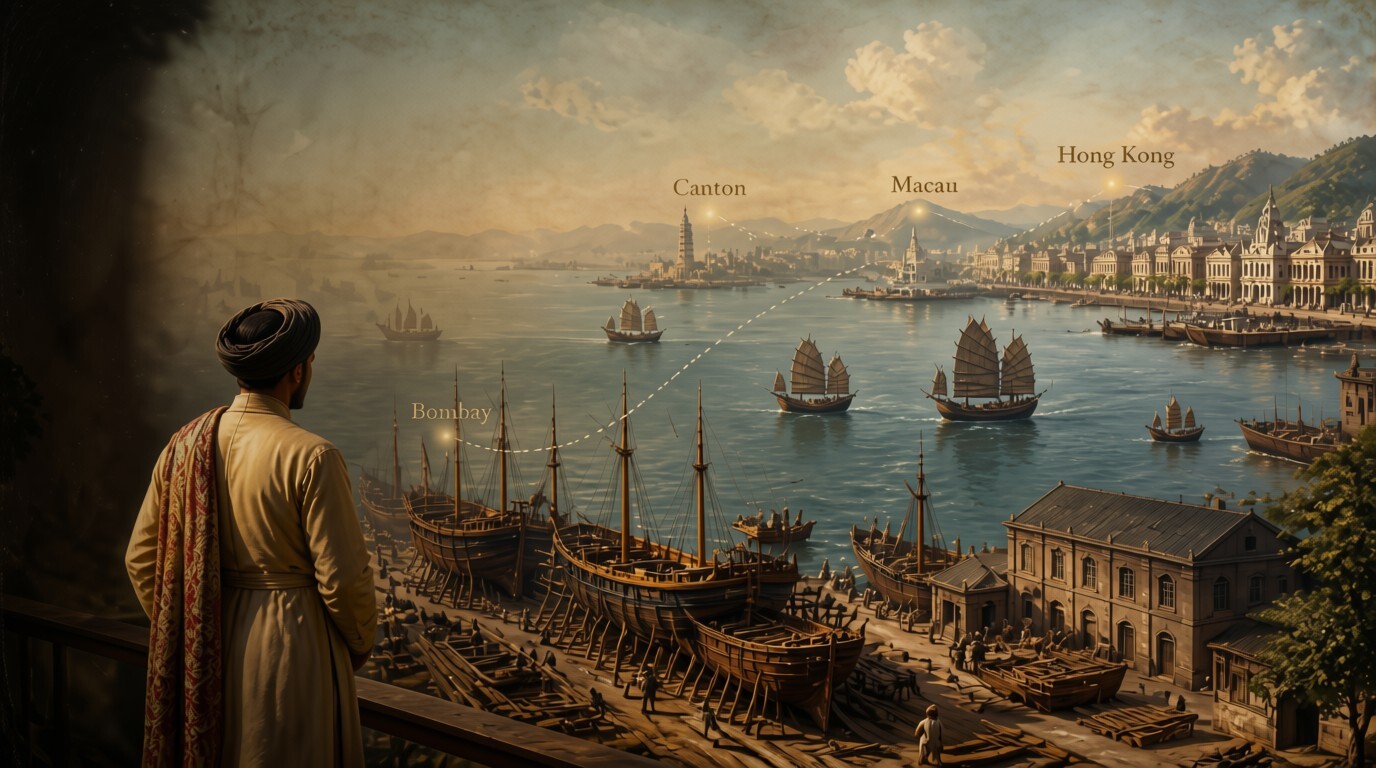
The history of the word “Mandarin” offers an unexpected example. Today, the term is used for the standard form of Chinese. Yet the word itself is not Chinese. Its origins can be traced to the Sanskrit mantrin, meaning an adviser or counsellor. The word entered other Asian languages before Portuguese traders encountered it and rendered it as mandarim. In Portuguese usage, it came to refer to Chinese officials and was eventually extended to the language associated with them.
The journey of mantrin to Mandarin does not mean that Sanskrit entered the Chinese language. In fact, the word reached English through a route that passed largely outside China, pointing to a broader and interesting feature of linguistic exchange. A word may pass through several languages before reaching its eventual destination, and each stage can alter its sound, meaning or use. The result may look very different from the original, while still retaining something of the language from which it came.
This makes language a useful way of studying cultural exchange. The path a word takes can reveal the routes along which people and ideas once moved. At the same time, the changes made to that word reveal something about the society that received it. Linguistic influence, therefore, is rarely a one-way process.
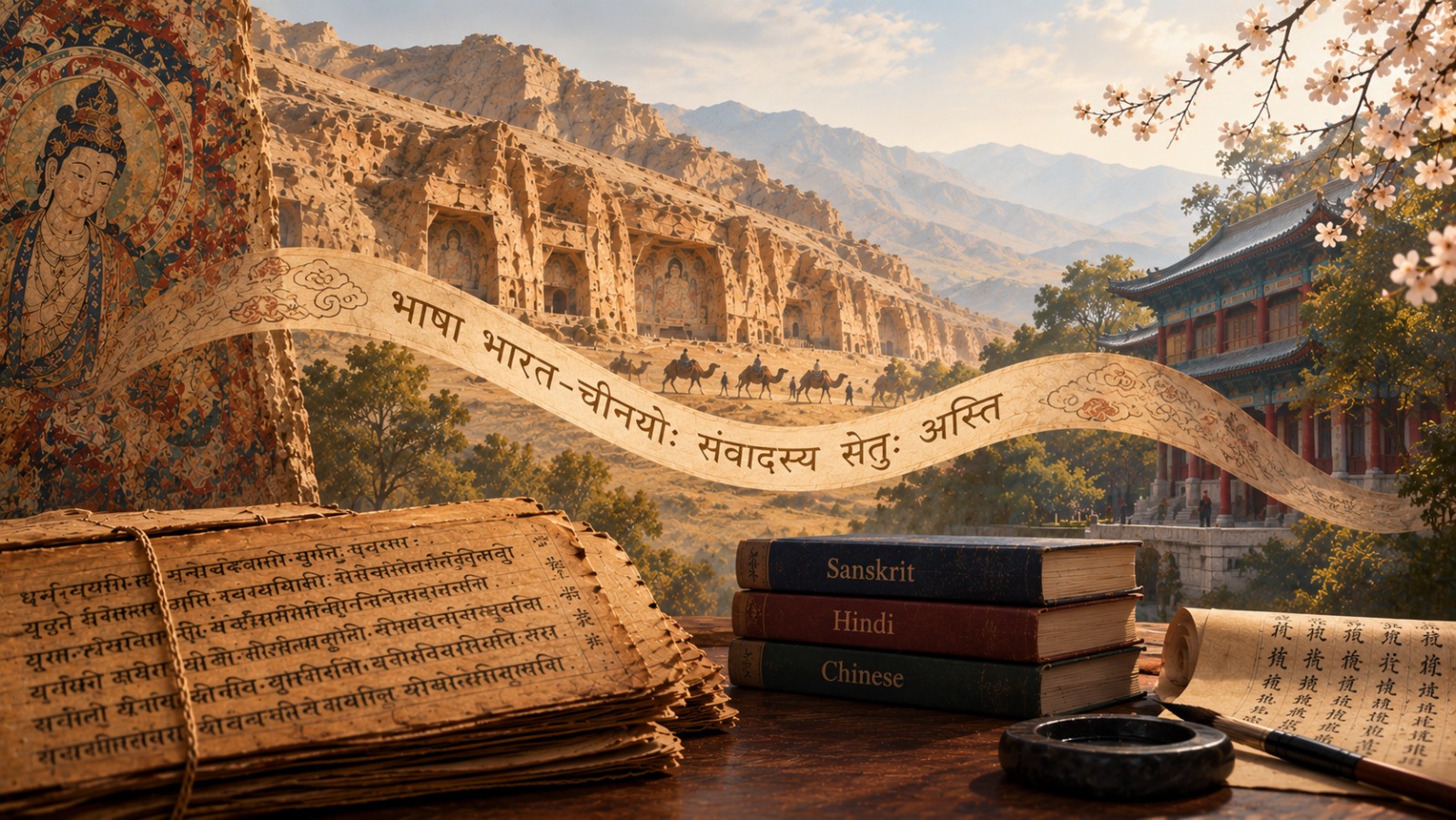
The history of Indian languages in China presents a deeper example of this process. Here, the encounter was not limited to words passing between languages. It involved the translation of religious texts, the transmission of knowledge and eventually the systematic study of Indian languages by Chinese scholars. Sanskrit and Hindi entered China at very different moments and for different reasons, but both became part of a longer history of how Indian ideas and languages were understood, adapted and studied in China.
Sanskrit Enters China
The earliest sustained encounter between Indian and Chinese languages was closely connected to the spread of Buddhism. As Buddhist texts moved from India towards China, their ideas had to be expressed in a language that had no established vocabulary for many of the concepts they contained. Translation was therefore not simply a matter of finding equivalent words. Chinese translators had to decide when an Indian term could be expressed through an existing Chinese word and when its sound or form needed to be carried across more directly.
This process gradually left a mark on Chinese religious vocabulary. Sanskrit terms were sometimes transliterated into Chinese, preserving something of their original sound, while others were translated according to their meaning. Nirvāṇa, for instance, became 涅槃 (nièpán), a phonetic rendering that allowed the Indian term to enter Chinese Buddhist writing without being reduced to an approximate Chinese equivalent.
Kumārajīva became one of the most important figures in this history. Born in Kucha to an Indian father and a mother from Kucha, he entered a world where Indian, Central Asian and Chinese traditions already intersected. His translations of Buddhist texts into Chinese became highly influential and helped shape the vocabulary through which Buddhism was understood in China. His story also illustrates why the history of Indian languages in China cannot be reduced to a simple movement from one civilisation to another. The knowledge travelled through Central Asia, encountered local languages and was then reworked within China.
Kumarajiva in front of Kizil Caves, Kuqa, Xinjiang, China.

Centuries later, the journeys of Faxian and Xuanzang represented another stage of this linguistic encounter. Their travels to India were partly driven by the need to access Buddhist knowledge at its sources, but the texts they brought back had to enter a Chinese intellectual world through translation. In this sense, the history of Sanskrit in China was shaped not only by the presence of Sanskrit texts, but by the sustained effort to understand what could be carried from one language into another.
From Translation to Language Study
By the twentieth century, the study of Indian languages in China had begun to move beyond the needs of Buddhist translation. Sanskrit was increasingly treated as a subject of academic study, while Hindi emerged as a way of engaging with modern India.
Peking University became an important centre of this development. The university traces its Indian Studies tradition to 1917, when it began offering courses in Indian philosophy. Sanskrit courses followed in 1919, with Ferdinand Diedrich Lessing becoming the university's first Sanskrit instructor. In 1942, Hindi was introduced at the National College of Oriental Languages in Chenggong, Yunnan. The institution later moved to Nanjing before being incorporated into Peking University in 1949. Sanskrit and Pali were established within the university's Department of Eastern Languages and Literatures in 1946.The institutional structure expanded more clearly in the 1940s. Hindi was introduced in 1942 at the National College of Oriental Languages, which was later incorporated into Peking University in 1949. Sanskrit and Pali were established as formal fields of study in 1946, when Ji Xianlin joined the university and helped establish its Department of Eastern Languages and Literatures.
The development of these programmes also reflected the changing purpose of language study. Sanskrit offered access to ancient Indian texts, Buddhist literature and the intellectual history surrounding them. Hindi served a different purpose, being a modern language, it allowed Chinese students to engage directly with contemporary Indian society and its literature. The two therefore occupied different positions within Chinese scholarship, even though they were brought together under the broader study of Indian languages and literature.
The people who built these programmes were themselves products of linguistic exchange. Ji Xianlin had studied Sanskrit, Pali and Tocharian in Germany before returning to China and taking charge of the Department of Eastern Languages and Literatures at Peking University. Jin Kemu joined him in 1948 and became another important figure in the development of Hindi and Indian Studies. Around the same period, the Indian scholar P. C. Bagchi was invited to Peking University, where he taught Indian culture and the history of Sino-Indian relations.
Mr. Ji Xianlin at work in 1966.

Source: https://www.guandian.cn/article/20090711/84233.html
This was therefore not simply China beginning to “study India”. Chinese and Indian scholars were participating in the formation of the field itself. Indian teachers contributed to the teaching of modern languages, while Chinese scholars trained in Indian languages produced translations and research that made Indian texts accessible to Chinese readers. The direction of influence was not fixed. Each side helped determine how the other was understood.
Over the following decades, the institutional base widened. Urdu was added in 1954 and Bengali in 2004. In 1960, Peking University admitted its first undergraduate cohort in Sanskrit and Pali, alongside established programmes in Hindi and Urdu. The university's present Department of South Asian Studies now teaches Sanskrit, Pali, Hindi, Urdu, Bengali and Tibetan, while its research extends into ancient Indian philology, Buddhist literature and China–India cultural exchange.
A Continuing Field
The study of Indian languages in China is not just confined to an earlier generation of Indologists. In 2025, Peking University hosted a youth dialogue on China-India cultural exchange that brought together students, scholars, media professionals and representatives of Chinese and Indian youth.
The university has also continued to place its present Hindi students in direct contact with this institutional history. In March 2025, Hindi faculty took undergraduate students to the university's centenary exhibition on Indian Studies, which documented the development of the discipline and its links with Sino-Indian intellectual exchange.
The contemporary picture, therefore, is less about the mass popularity of Sanskrit or Hindi in China than about the persistence of specialised study. Sanskrit continues to provide access to an important body of classical and Buddhist literature, while Hindi gives Chinese students a route into modern India. Both remain part of an academic tradition that has changed considerably since its early beginnings.
The history of Indian languages in China ultimately reveals how linguistic exchange can outlast the circumstances that first produced it. Sanskrit entered China through the movement of Buddhist knowledge and was gradually transformed into a field of academic study. Hindi arrived much later through modern educational institutions. Their histories are different, but both show how a language can acquire a new life in another intellectual setting. What began as an effort to understand foreign texts and traditions eventually produced a body of scholarship in which Indian and Chinese scholars became participants in the same field. The continuing study of these languages in China is therefore not simply a remnant of an older cultural encounter; it is, in fact, one of the ways in which that encounter continues to be interpreted.