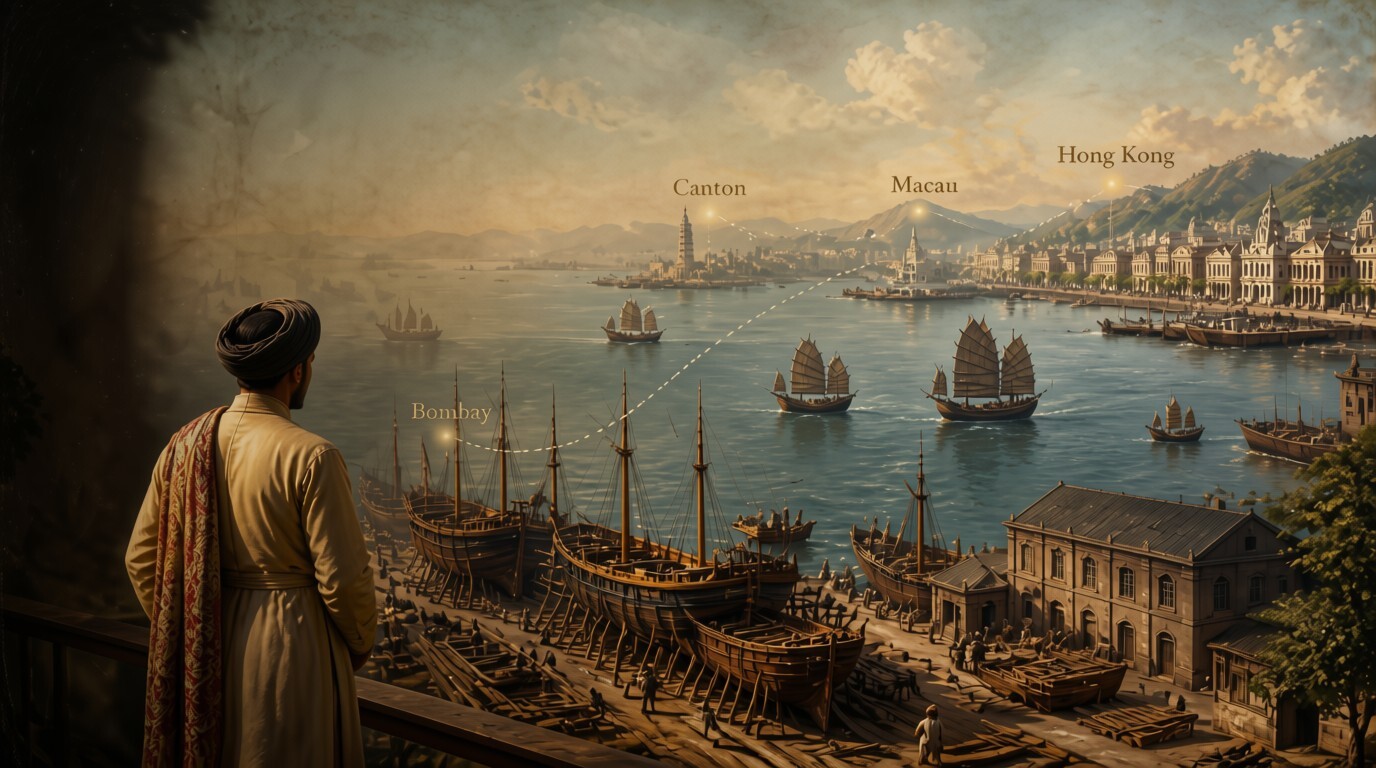
In 1756, two Parsi brothers, Hirji Jivanji and Mancherji Readymoney, established what is recorded as the first Parsi commercial firm in Canton, present-day Guangzhou. Their arrival did not mark the beginning of contact between Zoroastrians and China, but it marked the beginning of a much more visible Parsi presence in the China trade. From Canton, the community would eventually extend its presence to Macau and Hong Kong, becoming part of the commercial networks that linked British India with the China Seas.
The story is intriguing partly because of the size of the community. Parsis were a small community in India, descended from Zoroastrians who migrated from Persia to the western coast of India centuries earlier. Yet their numbers never quite reflected their influence across continents. In Bombay, Parsi entrepreneurs became prominent in shipping, industry and philanthropy. In China, their imprint was smaller in numbers but remarkably visible in the institutions and infrastructure of Hong Kong.
The Parsi connection with China, however, did not begin in the eighteenth century. Long before Readymoney arrived in Canton, Persian and Zoroastrian merchants had been travelling along the routes connecting Iran, Central Asia and China. Research on the Tang period records the movement of Persian merchants into Chinese territories, particularly through the overland and maritime routes that connected the Persian Gulf with China's southern ports. Persian merchants were active in places such as Guangzhou, and Zoroastrian communities existed in China alongside other foreign religious communities.
For the Parsis, migration to the China trade was closely connected to the opportunities created by the expansion of British commercial networks. Parsis had already established themselves as merchants, shipbuilders and financiers in Bombay. Their knowledge of English, commercial experience and connections with British India allowed some families to participate in the expanding trade between India, Southeast Asia and China.
The names that followed Readymoney included the Banajis, Wadias, Camas, Vikajis and Parakhs, alongside the better-known Jejeebhoys. Their activities stretched across Canton, Macau and eventually Hong Kong.
When a Bombay-built ship carried the treaty that changed Hong Kong
One of the strangest connections between the Parsi history of India and the history of Hong Kong can be found in an event that had little to do with Parsis themselves. In 1842, the Treaty of Nanking was signed aboard HMS Cornwallis, formally ending the First Opium War and ceding Hong Kong to Britain. The ship had been built at Bombay Dockyard by the Wadia family, the celebrated Parsi shipbuilders of Bombay. The Wadia shipbuilders had produced some of the British Royal Navy's most important vessels in the nineteenth century, demonstrating the technical importance of Parsi craftsmanship to the maritime infrastructure of the British Empire.
Signing of the Treaty of Nanking, in the State Cabin of H. M. S. Cornwallis, 29 Aug 1842

Source: https://www.rct.uk/collection/751141/signing-of-the-treaty-of-nanking-29-aug-1842
The connection is therefore almost circular; a ship constructed by Parsi craftsmen in Bombay carried the treaty through which Hong Kong became a British colony. Parsi merchants would subsequently become part of the commercial society that developed there. It is a small historical detail, but one that neatly captures the wider India-China connection running through the Parsi story.
Building a city
By the late nineteenth and early twentieth centuries, Parsis were no longer simply participants in Hong Kong's commercial world. Some had become among its prominent businessmen and philanthropists. Perhaps the most consequential was Sir Hormusjee Nowrojee Mody. Mody arrived in Hong Kong in the late 1850s and became a successful merchant, broker and land developer. He was involved in major commercial and public projects and eventually became one of the principal figures behind the establishment of the University of Hong Kong. When the proposed university appeared close to collapse for lack of financial backing, Mody stepped forward with an offer of HK$150,000 to construct the university's main buildings. He ultimately met the full cost as construction expenses rose.
The foundation stone laying ceremony of the University of Hong Kong, on March 16, 1910. Photo: University of Hong Kong

Mody's name survives in the city in another way. Mody Road, in Tsim Sha Tsui, was named after him in recognition of his contribution to Hong Kong. Every year, members of Hong Kong's Zoroastrian community commemorate Mody's birthday at the University, where a Zoroastrian priest places a garland on his bust. More than a century after his death, the ritual keeps the Parsi presence visible within one of Hong Kong's most important institutions.
Each year on October 12, the Zoroastrian community honours Sir H. N. Mody’s birthday with a garland ceremony at his bust in the Main Building.

Source: https://www.giving.hku.hk/zh/named-building/main-building
If Mody helped build Hong Kong's intellectual infrastructure, Dorabjee Naorojee Mithaiwala left his mark on the city's everyday movement. Mithaiwala, a Parsi Zoroastrian, established the Kowloon Ferry Company, beginning passenger ferry services across Victoria Harbour. The company operated the Morning Star and later expanded its fleet. The service eventually became the Star Ferry, one of Hong Kong's most recognisable institutions. The Star Ferry's own history traces its origins to Mithaiwala in 1880. The ferry connected Hong Kong Island and Kowloon at a time when the harbour was a fundamental barrier to the movement of people and goods.
The Parsi contribution however was not confined just to business. Jehangir Hormusjee Ruttonjee, another prominent Parsi businessman, became associated with Hong Kong's public-health infrastructure. After the death of his daughter from tuberculosis in 1943, Ruttonjee supported efforts to combat the disease. The Ruttonjee Sanatorium was established in 1949 and became an important institution in Hong Kong's fight against tuberculosis. It was later redeveloped as Ruttonjee Hospital.
Mody, Mithaiwala and Ruttonjee consequently represent three different forms of Parsi influence across domains in Hong Kong: education, urban infrastructure and public health. Together, they demonstrate why the Parsi story in Hong Kong cannot be reduced to a history of merchants moving between ports. Their contribution became embedded in the institutions through which the city went onto develop.
A community caught between worlds
Yet the story also has another side. Despite its historical influence, the Parsi community in Hong Kong has remained remarkably small. Estimates have generally placed its population at around 200, even as the community's commercial prominence declined over the twentieth century. The decline was linked to changes in the commercial environment and migration of Parsis to other locations.
The 1997 handover introduced another layer of uncertainty for non-Chinese communities. Chinese nationality after 1997 was governed by the PRC Nationality Law and its specific implementation in Hong Kong; people who were not Chinese nationals did not automatically become Chinese citizens, while those who qualified under Chinese nationality law were treated as Chinese nationals. Foreign nationals and stateless persons could also apply for naturalisation subject to the law.
For the Parsis, the deeper issue was therefore not simply about citizenship but also a question of belonging. They were Indian by historical origin, Zoroastrian by religion, shaped by British colonial institutions and, for generations, residents of Hong Kong. Their history does not fit neatly into a single national category. That is perhaps what makes the Parsi story particularly useful for understanding the history of exchanges between India and China.
The Parsi presence in Hong Kong was never large enough to dominate the city demographically, and therefore its importance came from elsewhere. It came through mobility, commerce, craftsmanship and institution-building. The Parsi experience in Hong Kong offers a different way of thinking about the India-China civilizational connection. It reminds us that such connections were not forged solely through states, diplomats or armies, but also through the quieter movement of people, ideas, skills and capital across the sea. In that sense, the Parsi story is one of the many human stories of exchanges through which that connection has endured.