
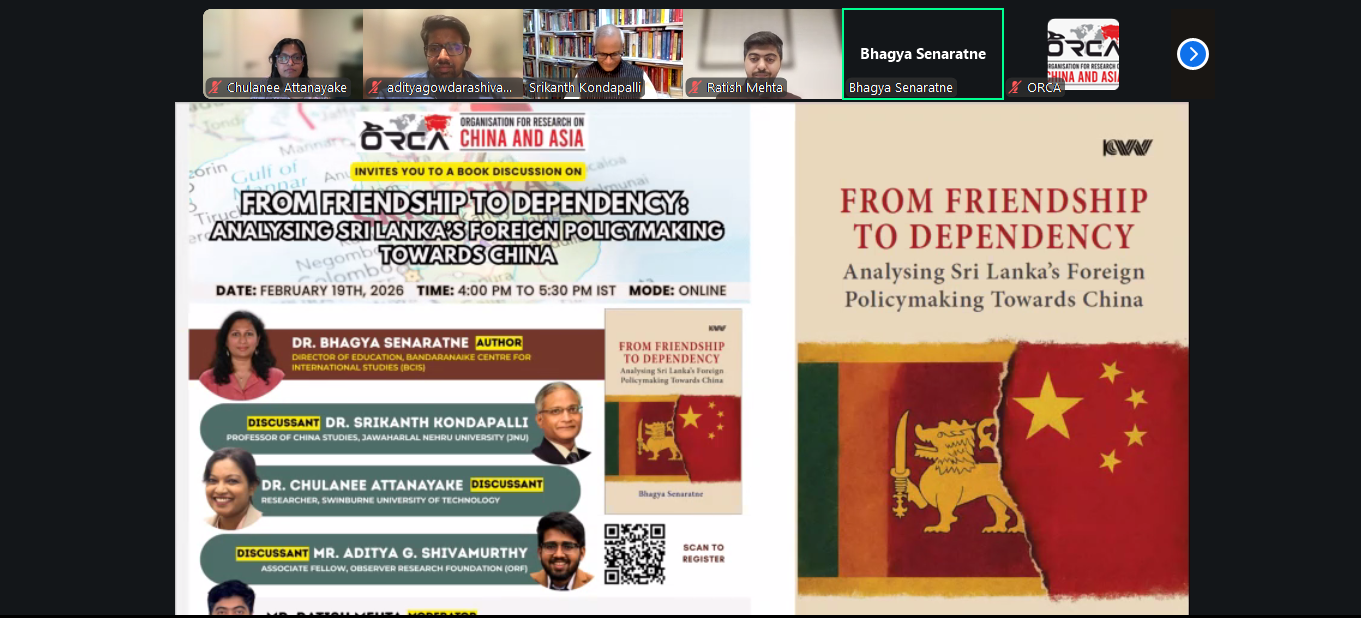
Organisation for Research on China and Asia (ORCA) hosted an online book discussion on From Friendship to Dependency: Analysing Sri Lanka’s Foreign Policymaking Towards China by Dr. Bhagya Senaratne. The session was moderated by Senior Research Associate Mr. Ratish Mehta and featured remarks from Dr. Srikanth Kondapalli, Dr. Chulanee Attanayake, and Mr. Aditya Gowdara Shivamurthy. The conversation revolved around the central question of “friendship versus dependency,” examining the domestic political factors shaping Sri Lanka’s China policy and the ways in which small states retain agency amid intensifying great-power competition.

Dr. Senaratne opened the discussion with an overview of her book, situating Sri Lanka’s engagement with China within a neoclassical realist framework. While acknowledging the influence of systemic pressures, she underscored the decisive role of domestic politics, public opinion, and institutional dynamics in shaping Colombo’s foreign policy decisions.

Dr. Kondapalli drew attention to the book’s analytical structure of independent, intervening, and dependent variables. He elaborated on Colombo’s hedging behaviour, the elite-level consensus surrounding port infrastructure projects, and Beijing’s political outreach via the Communist Party of Sri Lanka.

Dr. Attanayake cautioned against viewing Sri Lanka-China bilateral relations through a simplistic binary lens. Instead, she argued that the relationship illustrates how smaller states navigate external financing and geopolitical rivalry, with infrastructure emerging as a form of strategic currency.

Mr. Shivamurthy emphasized Sri Lanka’s agency in the post-war reconstruction phase, noting that Chinese funding responded to pressing developmental imperatives. He also highlighted India’s significance as a regional actor, positioning it within Colombo’s broader balancing strategy.

Moderator Mr. Mehta anchored the discussion around the “friendship versus dependency” debate, prompting reflections on the scope of Sri Lanka’s autonomy, subtle pressures reflected in UN voting behaviour, and the operational space available to small states in a competitive great-power environment.

The event concluded with an engaging Q&A session, where participants raised questions about how small states like Sri Lanka manage strategic competition, sustain non-alignment, and preserve autonomy in the context of evolving US policies.