
The recent introduction of the “Law on Promoting Ethnic Unity and Progress” (中华人民共和国民族团结进步促进法) marks an important moment in how the Communist Party of China (CPC) approaches ethnic governance. Its formal adoption on 12th March, 2026 brought together a range of existing policies and administrative practices into a single, more coherent legal framework. On the surface, the law is presented as a way to promote harmony, development and shared prosperity among China’s 56 recognised ethnic groups. However, it reflects a broader ambition to shape how identity itself is understood. It seeks to standardise cultural expression, regulate belief systems and align social life more closely with state-defined ideas of nationhood.
The law covers areas such as education, language, urban planning religion, digital governance and national security. It promotes Mandarin as the primary language in schools, places responsibility on families to foster patriotism and reinforces the “Sinicisation” of religion. Additionally, it emphasises the use of digital tools and public infrastructure to guide public discourse and limit the visibility of aspects seen as harmful to unity. The tone of the law is set clearly in its preface, which states that “realising the great rejuvenation of the Chinese nation is the common pursuit of all Chinese sons and daughters” and that safeguarding unity and promoting ethnic solidarity is a shared responsibility. Thus, the law presents that the ideal of “unity” can be achieved through the institutionalisation of compliance in state-governed institutions.
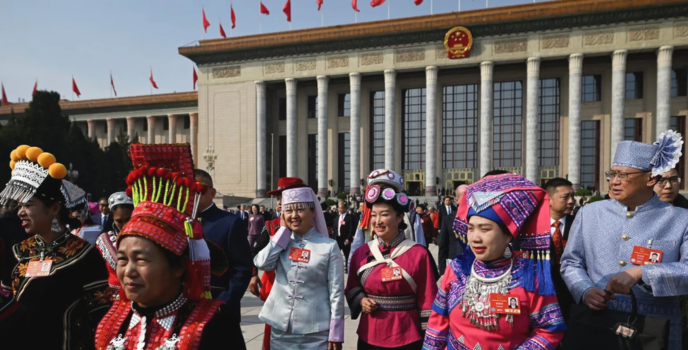
The Law on Promoting Ethnic Unity and Progress reflects the CPC’s vision of a cohesive national identity that asks its citizens to disregard ethnic differences and adopt a shared sense of belonging to the Chinese nation. This vision is presented in Xi Jinping’s repeatedly espoused metaphor of China’s ethnic groups being “closely united like pomegranate seeds” (我们五十六个民族要像石榴籽一样紧紧抱在一起). It is a powerful imagery of strength through unity. However, it also implies a level of assimilation and uniformity that leaves little room for distinct identities to thrive.
Institutionalising Patriotism
At the forefront of the law’s justification is economic success. Chinese officials point to the elimination of extreme poverty in 420 counties across ethnic autonomous regions, as well as improvements among 28 smaller ethnic groups. The language of the law reinforces this connection, tying development directly to national unity. Seen through the lens of social contract theory, this framing reflects that the state derives its authority from its ability to deliver traditional developmental benefits. By emphasising poverty alleviation and economic growth, the CPC positions itself as fulfilling its side of this contract. In return, the Chinese population is seen as being obligated to adopt policies that promote assimilation and unity.
The law explicitly tries to embed patriotism into the institutional fabric of society. It brings education, religion and even family life into this effort, encouraging a shared sense of belonging and strengthen a “community of the Chinese nation.” Article 15 mandates the comprehensive promotion of Mandarin as the national common language, positioning it as the primary medium of education. While minority languages are nominally protected, the prioritisation of Mandarin effectively marginalises them in practice. A similar policy has previously been adopted regionally in Inner Mongolia and led to a spate of widespread protests in 2020. One of the law’s clearest provisions is its strong push for the national common language to be used as the main medium of education. This makes it harder for minority languages to hold a meaningful place in schools. Thus, what began as a regional policy change in Inner Mongolia has now become part of an extensive national framework. Additionally, the law is drafted to respond to the kind of resistance that erupted in 2020. It legally links education to national identity and security, allowing the CPC to enforce a uniform language of instruction. In doing so, it leaves less room for opposition by penalising any protests.
The law extends into the private sphere as well, shaping aspects of everyday life that were previously less directly regulated. Parents and guardians are legally obligated to ensure that minors develop loyalty to the state, the CPC and the broader Chinese nation. Crucially, they are prohibited from instilling ideas deemed “detrimental” to ethnic unity, a vague standard that could encompass a wide range of cultural or political expressions. Religion is also brought more closely in line with state objectives. The law reinforces the policy of “Sinicisation,” asking religious groups to adapt to socialist society and promote patriotism among followers. Moreover, it is an extension of earlier statements made by Xi Jinping during Politburo group study sessions, where he emphasised the need to ensure that religions in China are “Chinese in orientation” and adapt to socialist society.
Migration, Gentrification and Embedded Communities
Beyond ideology, the law reflects a deeper and ongoing effort to reshape the demographic reality of ethnic regions. State-led migration and urban development programs have steadily encouraged the movement of Han Chinese populations into minority-dominated areas. In traditionally Uyghur dominated Xinjiang, the proportion of Han residents has risen sharply over the past decades, driven by state employment schemes, infrastructure expansion and security-oriented settlement policies and measures like the Ethnic Unity Law.
At the center of Xinjiang’s demographic transformation is the Xinjiang Production and Construction Corps (XPCC), established in 1954. Its settlements are scattered across the region like blocks embedded within larger prefectures, giving it wide reach and control. Since its inception, it has encouraged Han settlement through farming projects, industrial jobs, and state-backed incentives, reshaping local populations. The importance of the XPCC has grown in recent years with the increase in policies aimed at promoting ethnic unity. Xi Jinping has repeatedly described it as a “strategic force” for national stability and border defense, calling for deepened reforms to strengthen its role in Xinjiang. The new Ethnic Unity Law consolidates existing policy directions and administrative practices, giving formal reform and legal backing to this model. Under this framework, minority communities are expected to adhere more strictly to the social contract and actively adopt the majority language and culture in the name of unity. The law makes this expectation very clear by mandating the use of Mandarin in education, calling for the “Sinicisation” of religion and placing responsibility on minority communities to instill a unified national identity.
Urban planning policies further accelerate these dynamics. In both Xinjiang and Tibet, redevelopment projects have transformed traditional neighborhoods into standardised, state-designed urban spaces that are easier to integrate into the nation-building project. The Ethnic Unity and Progress Promotion Law reinforces this shift by giving it a clearer legal and ideological foundation. Its emphasis on promoting “socialism with Chinese characteristics ” and displaying the “image of the Chinese nation in planning and architectural design” aligns closely with how these spaces are being redesigned and repurposed. In many ways, these redesigned spaces reflect the same ideal of communities being “closely united like pomegranate seeds,” where diversity is retained but reorganised into a uniform and state-defined structure. An example of this approach is the construction of the “liberation of the million serfs” memorial hall in 2021 in Tibet. This has been accompanied by a growing network of museums and exhibition sites that are officially designated as “patriotism education bases,” linking physical redevelopment with ideological education. The new law explicitly supports the acceleration of such efforts by encouraging the use of public institutions to instill patriotism among all ethnicities.
Digital Governance and the Globalisation of State Control
Article 31 of the newly passed law promotes the use of big data and artificial intelligence to shape narratives around ethnic unity, while restricting content that could undermine it. This builds on earlier efforts by the CPC to construct what it often describes as a “harmonious and orderly” cyberspace, a concept reinforced through white papers and regular “clean-up” efforts. Digital platforms are expected to actively produce and amplify state-approved narratives and filter out opposition. These provisions further strengthen the authority of bodies such as the Cyberspace Administration of China (CAC), while also guiding them to discipline institutions and online platforms that do not align with state-defined standards of unity. The new law however, connects this digital control to a broader international strategy. Official discourse put forth at forums like the World Internet Conference promotes the idea of a “community with a shared future in cyberspace.” This vision is promoted as a cooperative and stable alternative to more open internet models. It also emphasises upholding cybersecurity to allow for “orderly” internet development. The new law realises this vision and extends China’s reach into global internet and academic spaces by allowing for legal action against individuals and organisations outside China. Diaspora communities, human rights organisations and academic institutions thus fall under great scrutiny.
Overall, by linking security so closely with unity, the law allows the CPC to justify extensive intervention in the personal and cultural lives of its citizens, while also monitoring and controlling international dissidents. These provisions work together to embed state priorities into everyday life, from education and family structures to urban planning and online spaces. It reinforces a model where cultural expression and even knowledge production is shaped within a framework of patriotism and national security. What sets this law apart is how it extends this logic beyond China’s borders. Its provisions allow for action against individuals and institutions outside the country, bringing global academic and digital spaces within its purview.
Image Credits: HKFP
Author
Chitra Nair
Chitra Nair is a postgraduate in Chinese Studies from SOAS University of London, holding a bachelor’s degree in International Relations with a minor in Environmental Studies from FLAME University, India. Her research explores contemporary Chinese politics, digital activism, political expression and censorship. She is especially interested in how the state and citizens negotiate power and legitimacy, questions which she seeks to explore through a political sociology lens. She previously interned at the Institute of Chinese Studies, New Delhi, where she published work on media censorship and the queer community in China. Her dissertation, Digital Panopticon : Activism and State Surveillance in China, examines digital activism and censorship in China through three key case studies.