
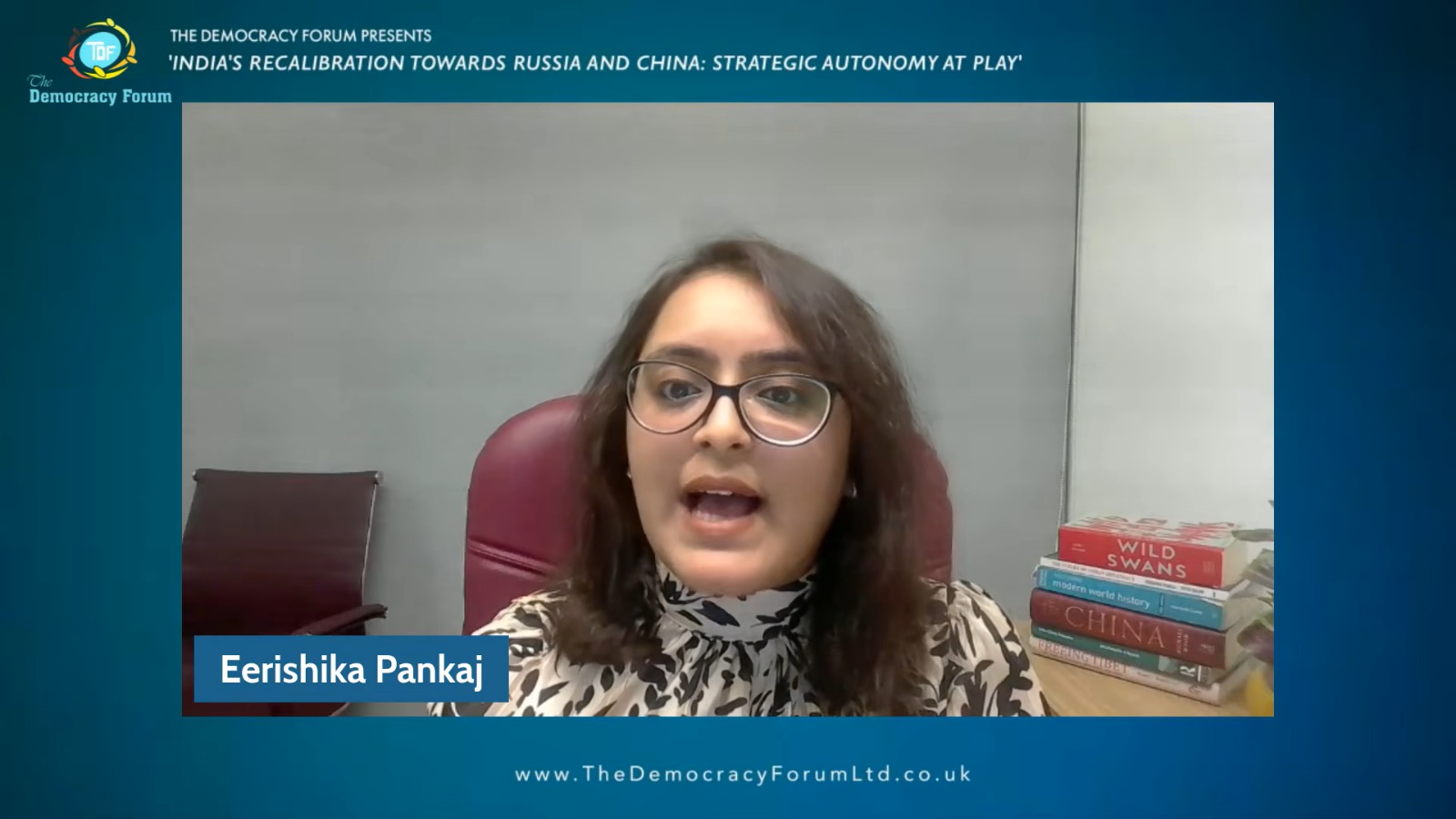
On 24th February 2026, The Democracy Forum (TDF) and TDF President Lord Charles Bruce hosted a webinar titled “India’s Recalibration towards Russia and China: Strategic Autonomy at Play.” The session examined how New Delhi is navigating intensifying great-power competition while preserving its long-standing commitment to strategic autonomy. Organisation for Research on China and Asia (ORCA)'s Director Ms. Eerishika Pankaj, represented the organization at the event. The discussion also featured panellists Professor Jagannath Panda, Dr. Sreeram Chaulia, and Professor Amitabh Mattoo. The online debate was chaired by Mr. Humphrey Hawksley, with closing comments delivered by Mr. Barry Gardiner. It reflected on whether India’s evolving engagement with Moscow and Beijing signals tactical hedging or a deeper structural recalibration amid a shifting global order.

During the debate, Ms. Pankaj situated India’s foreign policy choices within a framework of structural realism and geopolitical continuity. She argued that what appears as “recalibration” is less a dramatic pivot and more a pragmatic response to a China-centric security architecture as well as shifting power balances and the consolidation of Sino-Russian ties. Ms. Pankaj highlighted that India’s continued defence and energy cooperation with Russia reflects both legacy interdependence and forward-looking strategic calculation. By maintaining engagement with Moscow, New Delhi seeks to preserve residual leverage, avoid overdependence on any single partner, and retain strategic flexibility in an increasingly polarized and uncertain international environment.

Ms. Pankaj asserted that India’s Russia policy operates within a complex triangular constraint. China’s rise is nudging India closer to the United States for external balancing, while US unpredictability encourages New Delhi to retain Russia as strategic insurance. At the same time, the growing convergence between Beijing and Moscow heightens the urgency for India to prevent a complete Sino-Russian alignment. She added that Chinese academic discourse interprets India’s Russia strategy differently, viewing India’s deeper engagement with the Indo-Pacific framework and the US as signaling a long-term drift toward the Western camp.