
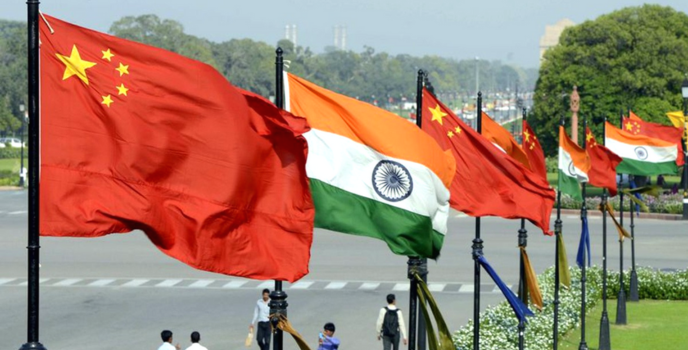
As 2026 dawns, India and China remain suspended in a relationship defined not by resolution, but by recalibration. The cautious diplomatic overtures following Indian Prime Minister Narendra Modi and Chinese President Xi Jinping’s meeting at the August 2025 Shanghai Cooperation Organization (SCO) Summit in Tianjin have injected a degree of tactical stability into the bilateral — but this is stability without strategic trust.
The Galwan shock may have faded from the headlines, yet it continues to cast a long shadow over disengagement talks, economic hedging, and multilateral diplomacy. In the year ahead, this relationship will not be remade, but it will be tested — across a spectrum of friction points ranging from unresolved boundary securitization and selective economic cooperation, to rival narratives of Global South leadership and other difference points in not just their respective methods but rather innate ideologies. 2026 offers not a reset, but a reckoning: whether the current détente can mature into a managed rivalry, or if enduring asymmetries will once again push the bilateral into reactive mode.
Economic Pragmatism with Strategic Guardrails
Economically, the two neighbours remain deeply interconnected. In 2024, China overtook the US to reclaim its spot as India’s top trading partner, even as India imposed new trade barriers and investment screens for security. Economic securitization will remain a central focus in 2026, with India’s China-plus One diversification aims becoming increasingly two-fold: to not just work towards its own diversification resilience needs when it comes to critical supply chains , but also present itself as a comparable manufacturing destination to other countries in their attempts to diversify away from China. For example, after early‐2020 shortages, India had once again relied on resumed Chinese shipments of fertilizers and rare earth magnets but faced Chinese export restrictions on them, as well as on tunnel boring machines, for months in 2025. In August 2025, despite Chinese Foreign Minister Wang Yi signalling a lift on these curbs while in India, the same was not confirmed by Chinese state media or ministry outlets. Such geoeconomic positioning will ensure heightened economic securitization remains in Delhi’s fiscal frameworks while dealing with Beijing in 2026 via investment screening regimes, rising anti-dumping measures and enhanced FDI scrutiny, particularly in technology-sensitive sectors.
Selective engagement will be an economically rational pathway that will shape India’s contemporary trade and investment behaviour as Chinese machinery and electronics continue to underpin India’s infrastructure expansion. Focused alignment to secure energy interests, such as India’s recent opening of dialogue with the US and the G7 on critical minerals, are likely to shape geoeconomic diplomacy. Concurrently, the reopening of Himalayan trade passes at Lipulekh, Shipki La, and Nathu La in August 2025, alongside the resumption of direct flights, signal a deliberate attempt to normalize logistical channels in line with the ‘early harvest’ proposal without diluting regulatory caution. As a result of such relaxation of trade restrictions, in the 2024-2025 financial year, China has remained the biggest single trade deficit India is running with any country, with the imbalance reaching an alarming USD 99.21 billion.
Even as the Indian Finance Ministry plans to scrap curbs –in place since the Galwan clash of 2020 –on Chinese firms looking to bid on government contracts, telecommunication and technological vulnerability remain hard ceilings with restrictions on Huawei and ZTE under India’s National Security cybersecurity directive. The continued prohibition on hundreds of mobile applications, and the insistence on transparency and joint-manufacturing frameworks underscore a risk-mitigation mindset. The necessity of this becomes more urgent when reviewing Xi Jinping’s New Year address that emphasises technology as a foundation of national power. The result is a pattern of pragmatic interdependence with embedded safeguards: economic exchange persists, but only within bounded, securitized corridors.
This likely trajectory will continue in 2026 looking toward diversified engagement, investment vetting that privileges domestic manufacturing, and strategic de-risking rather than outright decoupling, with the goal to bolstering domestic industries in line with self-reliance goals of both states. Vigilance is still warranted especially as tariff barriers and export restrictions may reemerge if broader tensions spike, so trade facilitation (with multilateral dispute mechanisms) should be emphasized over unilateral protections.
Managing a Militarized Frontier
The border remains the most consequential determinant of bilateral political trust. Currently along the Line of Actual Control (LAC), even as a full disengagement was reached via the October 2024 agreement at the hotspots — particularly concerning Depsang and Demchok — connected to the Galwan 2020 clash. The Tianjin SCO meeting in 2025 deepened the rhetoric of restraint, with Xi Jinping emphasizing development partnership and Prime Minister Modi cautioning against allowing differences to escalate into disputes. Corps Commander-level mechanisms and the Working Mechanism on Consultation and Coordination (WMCC) channels remain periodically operational as critical confidence building channels to reinforce this language of stabilization.
Nonetheless, the ground reality is one of entrenched militarization as troops deployed along the unresolved border remain prepared for contingencies, with infrastructure development such as India’s reopening of the Nyoma airbase and China’s training exercises being cautiously watched. Forward infrastructure, redeployed patrols, and the continued strategic ambiguity around “legacy” sectors risk sustained friction even within disengaged spaces. Recent reports of China building alleged permanent structures near the buffer zone of Pangong lake have been viewed with alarm in India. Despite being within Chinese territory, the structure sits just outside of 2020 disengagement zone, and improves the PLA’s ability to sustain year-round operations.
Furthermore, Pakistan’s strategic relevance to China’s border calculus — particularly in the Kashmir theatre and in relation to broader regional security alignments — continues to complicate Indian assessments of Chinese intent. The US Department of Defense’s annual report on China’s military developments has reiterated the importance of Pakistan as a security partner of the People’s Liberation Army (PLA), and the positive trajectory of defence ties between the two. Islamabad’s recent statement that China helped mediate the India-Pakistan tensions post the Pahalgam terror attack –after previously crediting US President Trump for the same –continues to concurrently show how agreeable it remains to placating China.
What emerges is not peace, but fragile tranquility: escalation risks are lower than in 2020–2022, yet postures remain hardened. Through 2026, this border environment is likely to continue being governed by procedural confidence-building and tactical risk-management as it remains the core tenet shaping all diplomatic and economic relations between India and China. For its part, Beijing must signal restraint by avoiding unilateral border infrastructure development or snap exercises in contentious sectors, and by involving India in any SCO-led security initiatives (such as counterterrorism, where both insist on non-interference).
Contest for Global Narratives
India and China will continue jockeying for leadership of the developing world in overlapping forums. Both stress South–South cooperation, but with distinct emphases. There remains a competition in place between the two Asian powerhouses to claim the mantle of the Global South leadership for which India pushes inclusive development, UN reforms and climate equity(as seen during the G20 presidency) while China projects Belt and Road investments as well as varied global initiatives (ranging across development, governance and civilization) to shape the South’s future.
In multilateral groups, too, contrasts remain. Meanwhile, within BRICS, India and Brazil see the bloc as an economic forum and have been cautious about de-dollarization, whereas China (and Russia) push more overt geopolitical agendas. New Delhi has even hesitated on BRICS expansion, fearing dilution of its voice. At the SCO, both India and China support anti-terrorism and connectivity, but India has in 2025 pulled out of SCO joint statements when terrorism — especially Kashmir-related attacks — was glossed over, underscoring that Sino-Pak dynamics complicate consensus. Such SCO dynamics also play out at the United Nations, especially as China continues to oppose India’s permanent seat ambitions at the United Nations Security Council, and in 2025 once again blocked India’s proposal to ban and designate as global terrorists five members of Pakistan-based Lashkar-e-Taiba (LeT) and Jaish-e-Mohammad (JeM).
Through 2026, both countries are likely to preserve distinct development narratives — India as democratic and pluralistic, China as stability-centric and state-led — even as they cooperate on discrete issues such as debt relief and climate adaptation. Key milestones to watch in 2026 will hence include India’s presidency of BRICS for the first time since 2016. How India and China negotiate the BRICS declaration — especially on finance and trade reform — will be telling. India will aim to steer BRICS toward development projects and anti-poverty initiatives, while China may push new currency and infrastructure schemes. Xi Jinping’s presence or absence (and any face-to-face with Modi) will signal the tenor of ties. Similarly, when Kyrgyzstan hosts the SCO 2026 meeting as president, India and China will both attend, reaffirming border peace and counterterrorism cooperation. However, broader SCO initiatives (e.g. a proposed anti-terrorism center) could see India and China delicately balancing between collaboration and suspicion.
Strategic Outlook for the India-China bilateral: What else to watch?
In 2026, the question of the Dalai Lama’s succession is potentially poised to resurface as another critical faultline in India–China relations, compounding the already complex interplay of border tensions, economic calibration and global-south rivalry. Beijing’s long-standing insistence on controlling the process of reincarnation will stand in direct opposition to the current Dalai Lama’s assertion that any legitimate successor must be identified outside Chinese political interference. While it has grown more cautious in referencing Tibetan autonomy in recent years, the succession debate will force India to confront the symbolic and strategic dimensions of its Tibet policy. In a year where border disengagement is still tentative and multilateral competing is intensifying, the Dalai Lama succession issue could emerge as an emotive and strategic flashpoint, testing India’s diplomatic balancing act between principle, pragmatism, and national interest.
After seven years without a full state visit, any official trip would matter. If Prime Minister Modi revisits China, or President Xi comes to India (perhaps on BRICS sidelines), it could catalyze new agreements. Conversely, cancelled or downgraded visits would be a setback. Furthermore, in 2026, the US holds the G20 presidency which means India and China will both navigate an “America First” agenda under President Trump. For India, hedged engagement remains the most viable strategic pathway. For instance, if US–China tensions deepen, India might find new incentives to partner economically with either side. Similarly, Russia–Ukraine dynamics could draw China and India into differing strategic cooperation (Moscow being a mutual SCO partner). India’s continuing relations with Russia (and with Iran/West Asia) may also intersect with China’s own Middle East initiatives, creating triangular considerations.
Expanding selective market access, leveraging resumed connectivity, and demanding reciprocity in trade while sustaining deterrence along the LAC allows New Delhi to balance openness with resilience. Diversification in critical technologies and supply chains — as reflected in India’s global advocacy on de-risking — should continue to anchor economic security doctrines. For China, demonstrating restraint in border infrastructure behavior, honoring disengagement protocols, and easing non-tariff barriers for joint ventures would meaningfully lower Indian threat perceptions. Recalibrating development diplomacy toward capacity-building and transparency would also reduce skepticism regarding the strategic intent of large-scale projects.
In sum, 2026 should be a test of the new normal: whether the measured thaw of 2025 will hold or fray under pressure. The best outcome would be a stabilized frontier plus selective economic collaboration, alongside healthy competition for Global South leadership. The worst would be renewed border mobilization or diplomatic antagonism spilling into enhanced economic barriers. Realistically, we expect neither extreme: India and China will engage where interests align, but will keep defences raised elsewhere.
Author
Eerishika Pankaj
Eerishika Pankaj is the Director of New Delhi based think-tank, the Organisation for Research on China and Asia (ORCA), which focuses on decoding domestic Chinese politics and its impact on Beijing’s foreign policymaking. She is also an Editorial and Research Assistant to the Series Editor for Routledge Series on Think Asia; a Young Leader in the 2020 cohort of the Pacific Forum’s Young Leaders Program; a Commissioning Editor with E-International Relations for their Political Economy section; a Member of the Indo-Pacific Circle and a Council Member of the WICCI’s India-EU Business Council. Primarily a China and East Asia scholar, her research focuses on Chinese elite/party politics, the India-China border, water and power politics in the Himalayas, Tibet, the Indo-Pacific and India’s bilateral ties with Europe and Asia. In 2023, she was selected as an Emerging Quad Think Tank Leader, an initiative of the U.S. State Department’s Leaders Lead on Demand program. Eerishika is the co-editor of the book 'The Future of Indian Diplomacy: Exploring Multidisciplinary Lenses' and of the Special Issues on 'The Dalai Lama’s Succession: Strategic Realities of the Tibet Question' as well as 'Building the Future of EU-India Strategic Partnership'. She can be reached on [email protected]