
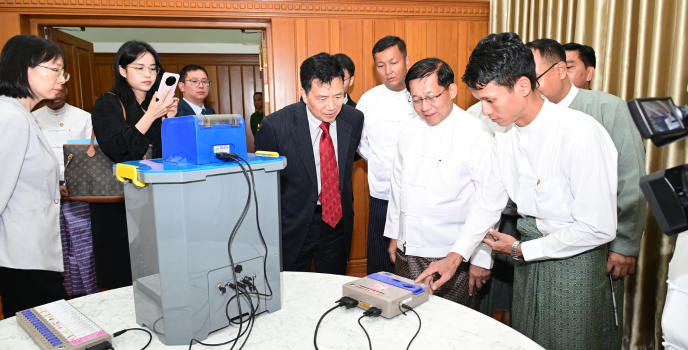
Nearly five years after the 2021 military coup, Myanmar’s junta has finally staged elections in three phases starting in late December 2025 and concluding in January 2026, covering 236 of the country’s 330 townships. While the military portrayed the vote as a pathway to peace and stability, the process unfolded amid conditions that severely undermined its credibility. Rather than demonstrating nationwide political participation, the recently held elections exposed the structural limits of the exercise. Almost half the population boycotted the process, and polling stations across multiple townships were closed, relocated to different places, or abandoned altogether.
Although the junta were able to pull off elections in selected urban areas and areas under their control, turnout was widely reported to be minimal as compared to the 2015 election, driven less by choice than by coercion. The election thus functioned less as a people-driven process than as a managed political ritual, designed to simulate normalcy without resolving the underlying conflict or restoring public consent. These conditions were compounded by structural exclusions that predated election day. Key opposition leaders remained imprisoned or barred from contesting, multiple political parties were banned, and large areas of the country remained inaccessible due to ongoing armed conflict.
International actors like the UK, Germany, the European Union, and the United Nations condemned the election and labelled it a “sham.” At the same time, ASEAN refused to send observers and signalled it would not endorse the poll, underscoring the lack of regional support for the junta’s political roadmap. Despite this, military regime leader Min Aung Hlaing declared the election a “success,” claiming an average turnout of “around 55 percent” in all three phases. But, Senior General Hlaing found a key external supporter on 26th January 2026 when Chinese Foreign Ministry spokesperson Guo Jiakun stated that “China congratulates Myanmar on a steady and orderly general election with active turnout”. Beijing was the first foreign country to officially welcome the conclusion of Myanmar’s junta-organised poll. Beijing’s swift endorsement was therefore not a neutral observation but a calculated move to extend legitimacy to the Myanmar military regime, whose leadership it views as predictable, negotiable, and strategically indispensable. In doing so, China once again defined legitimacy on its own terms - privileging strategic access, border stability, and economic interests over the expressed will of the Myanmar people.
Why China Backed Myanmar’s Election?
Although the junta sought to frame the recently concluded elections as a stabilising political milestone, their credibility was structurally undermined by ongoing fighting, continued airstrikes, and a boycott by nearly half the electorate. It was against this backdrop of contested legitimacy that China’s response became significant, as Beijing moved beyond routine diplomacy to actively adopt and amplify the junta’s narrative. Beijing framed the election as “generally stable and orderly” and reflective of “the choice of the people,” with Chinese Special Envoy for Asian Affairs Deng Xijun observing the process in Naypyitaw and attributing the election’s “successful conduct” to agreements between President Xi Jinping and Senior General Min Aung Hlaing. The dissonance between this portrayal and on-the-ground realities underscores that China’s support was more about extending political legitimacy. By echoing the junta’s claims, China effectively transformed observation into endorsement, signalling to both domestic and international audiences that the military-led election was legitimate.
This posture aligns closely with Beijing’s broader strategic calculus. Even a nominally elected government under continued military dominance offers China a more predictable and institutionally legible negotiating partner, lowering political and investment risk. Throughout the campaign period, the junta foregrounded China-backed mega-projects as signals of alignment- Min Aung Hlaing personally chairs the steering committee for Belt and Road Initiative projects, Prime Minister Nyo Saw heads the China–Myanmar Economic Corridor Implementation Committee, and Transport Minister Mya Tun Oo oversees the Muse–Mandalay railway project. The regime’s announcement to revive the long-suspended Myitsone Dam further underscored its intent to leverage electoral optics to reset stalled Chinese investments.
By endorsing the election despite its flaws, Beijing signalled that political predictability and alignment with Chinese priorities outweigh international scrutiny or regional consensus. The divergence with both global and regional actors demonstrates a deliberate trade-off, where Beijing prioritises a stable, compliant partner in Naypyitaw over adherence to international standards or ASEAN expectations, consolidating its strategic influence.
What’s Next in China-Myanmar Relations?
Chinese Foreign Ministry Spokesperson Guo Jiakun’s statement that China “stands ready to continue deepening comprehensive strategic cooperation with Myanmar” offers a clear indication of Beijing’s strategic roadmap. As expected, according to Myanmar’s Union Election Commission, Union Solidarity and Development Party (USDP) - a proxy political party for the military Junta - has secured 232 of 263 contested seats in the lower house (Pyithu Hluttaw) and 109 of 157 seats in the upper house (Amyotha Hluttaw). Myanmar’s parliament is expected to convene in March to elect a president, with a new administration set to assume office in April 2026. However, with the combination of the USDP’s parliamentary dominance and the military’s constitutionally guaranteed 25 percent of parliamentary seats under the 2008 Constitution, along with the USDP seats, the new administration will be filled with military elites. Such a government is unlikely to deviate from close alignment with Chinese interests and will remain structurally dependent on the military and inclined toward sustained cooperation with Beijing.
From Beijing’s perspective, this incoming government represents not a political transition but a rebranded continuation of military rule - one that nevertheless provides a more formalised and negotiable partner. China is therefore likely to treat the new administration as a partner to safeguard and expand its strategic interests in Myanmar. Once the government is in place, Beijing is likely to put pressure to reclaim the lost territories, especially surrounding key Chinese economic and strategic stakes, revive stalled Belt and Road Initiative projects such as the Myitsone Dam (previously suspended due to environmental and public opposition), accelerate plans for the Mandalay–Muse railway and expand access to Myanmar’s rare earth resources.
Moreover, China’s support is unlikely to be confined to economic engagement alone and is expected to extend into diplomatic and security domains. Even at present, Beijing remains one of the junta’s most consequential defence partners, supplying critical military hardware and inputs despite its public claims of non-interference. This relationship is likely to endure so long as Naypyitaw remains aligned with Chinese strategic priorities, reinforcing a transactional framework in which political loyalty and strategic access are exchanged for sustained diplomatic protection and military support.
China’s rapid endorsement of Myanmar’s election reflects a broader pattern in its regional diplomacy. In Beijing’s calculus, legitimacy is defined less by participation, competition, or international recognition than by predictability, compliance, and strategic alignment. By shaping the election narrative and endorsing a deeply flawed electoral process, China is institutionalising a model of stability that serves its interests first. Whether this approach can deliver durable stability or instead prolong conflict and further fragment Myanmar’s political landscape will be a litmus test for Beijing’s Myanmar policy.
Image Credit: The Global New Light of Myanmar
Author
Ophelia Yumlembam
Ophelia Yumlembam is a Research Associate at the Organisation for Research on China and Asia (ORCA). Before joining ORCA, she worked at the Dept. Of Political Science, University of Delhi, and interned at the Council for Strategic and Defence Research in New Delhi. She graduated with an M.A. in Political Science from the DU in 2023. Ophelia focuses on security and strategic-related developments in Myanmar, India's Act East Policy, India-Myanmar relations, and drugs and arms trafficking in India’s North Eastern Region. Her writings have been featured in the Diplomat, South Asian Voices (Stimson Centre), 9dashline, Observer Research Foundation, among other platforms.