

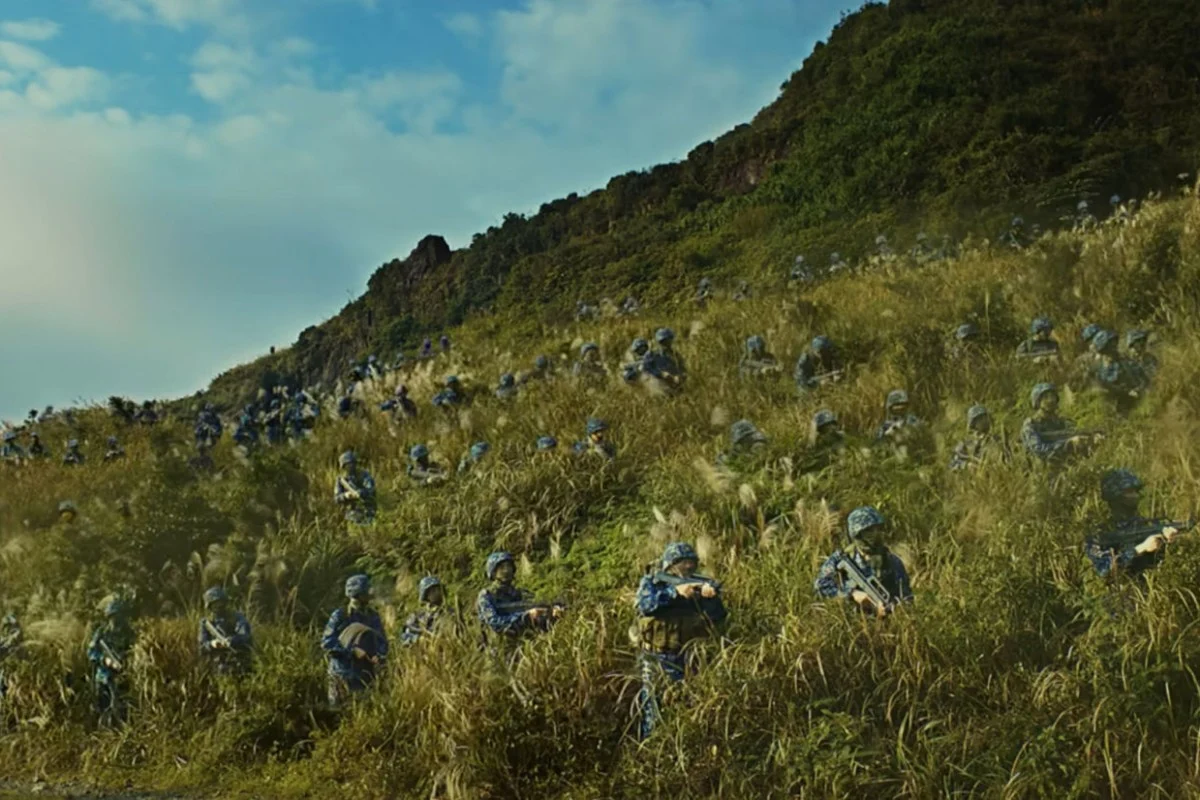
The Taiwanese television drama “Zero Day Attack” (零日攻击) began by charting the slow, corrosive nature of Chinese subversion against Taiwan, and its quiet intrusion upon everyday life. Episodes 8 and 9 significantly raise the stakes, however, as a blockade of Taiwan comes into force, war appears imminent, and Chinese-linked actors begin operating more openly. What had previously felt like a looming, shadowy threat becomes far more explicit and threatening.
Episode 8 centres on Chen Zhi Hao, a businessman contemplating whether or not to flee to China with his family. In episode 9, Sam, an ex-convict, agrees to take on one final job for ‘Big John,’ a gangster with ties to the Chinese Communist Party. Together, these episodes explore how the pressures of impending war push people toward decisions that ultimately prove catastrophic. More than anything, they function as a warning—when fear overrides principle, individuals can become instruments of subversion and are often discarded once they have served their purpose.
The Absurdity of Imminent War
The most striking feature of episodes 8 and 9 is their atmospheric shift from earlier instalments. With war approaching, the surreal disintegration of normal life occurs. Episode 8 captures this sense of unreality through a series of quiet vignettes. Chen Zhi Hao tells his wife, Lee Jia-Ru, that he is heading out for work, but instead spends his days in the park because his company has shut down operations in Taiwan. Jia-Ru receives a call regarding her father, from whom she has been estranged for decades. Now suffering from advanced dementia, the nursing home he had checked himself into is shutting down because its foreign care workers have left Taiwan. War dismantles fragile systems that sustain society.
Sound design reinforces this atmosphere. Orchestral music drifts through the neighbourhood, mingling with government announcements of a Sixth Combat Readiness Exercise—the show’s fictional stand-in for Taiwan’s annual Han Kuang drills. The music is presumed to be coming from neighbours who fled without turning off their stereo. Fighter jets streak overhead as a cat watches placidly from a garden, while armoured personnel carriers rumble past the bus Zhi Hao takes on his aimless commute.
Episode 9 initially adopts a similar tone. Convicts in a prison bus watch pro-CCP demonstrators harass soldiers manning defensive positions, underscoring the cognitive dissonance of a society facing invasion while still grappling with internal dissent. As the episode progresses, however, the tone darkens. An armed robbery at the Kaohsiung Credit Union and the shooting of a shop assistant in the Qishan district signal that state authority is fraying. What was background tension in episode 8 hardens into overt violence, preparing the ground for the moral collapse that defines episode 9.
Misguided Motives
What links the protagonists of episodes 8 and 9 is their indirect involvement with the Chinese regime for reasons that are deeply human and, on the surface, understandable. In episode 8, Chen Zhi Hao’s actions are shaped by his son Li Wei’s medical history. Li Wei previously required a kidney transplant, and Zhi Hao was forced to pay numerous bribes to secure a child donor—a pointed allusion to illegal organ harvesting practices associated with mainland China. His son’s health issues convince Zhi Hao that fleeing to the mainland may be the only way to keep him safe.
In episode 9, characters are similarly motivated by love. After his release from prison, Big John offers Sam NT$10 million to complete one final task—return to prison and help engineer a jailbreak. With the money, Sam dreams of taking his wife to Australia to start a new life. Comparable pressures drive Yu-Fang, the prison warden who facilitates the jailbreak. Her daughter needs a liver transplant, and Big John exploits this desperation. ‘Taiwan is going to lose, with or without your participation,’ he tells her, urging her to prioritize her child over abstract loyalties. In both episodes, personal incentives provide a rationalization for collaboration with subversive actors.
The Cost of Complicity
The final message of episodes 8 and 9, however, is unequivocal—betraying one’s country does not pay. Those who collaborate are used and discarded once their utility expires. In episode 8, Chen Zhi Hao is a member of a business association promoting cross-strait relations, reflecting Beijing’s cultivation of Taiwan’s business elite, and thus believes he has a safety net. Instead, he discovers he cannot access his funds in Chinese banks, and the company’s board liquidates his shares, citing his Taiwanese nationality as grounds for exclusion during the crisis. Finally, it is revealed that his wife has been blacklisted for signing a petition supporting Hong Kong’s Umbrella Movement, and ‘company property may be seized’ as a result, in a chilling illustration of the CCP’s expanding extraterritorial reach.
Alongside his escape plan, Zhi Hao’s family life disintegrates. His wife confronts him for secretly pawning her wedding jewellery to raise money. His son Li Wei, meanwhile, like many young people, sees himself as Taiwanese. When classmates bully Li Wei and call his father a traitor, he absorbs the attacks with bitter resignation. ‘I deserve it,’ he later says, ashamed of abandoning his country. The social fabric frays as well. The orchestral music haunting the neighbourhood is revealed to be an elderly woman’s alarm, her neighbours are too consumed by their own fears to notice her passing. Episode 9 delivers its warning even more brutally. Once Sam and the prisoners seize a district police station, Big John tips off the media, engineering a spectacle meant to undermine confidence in the government and legitimize a pro-Chinese ‘self-defence militia.’ No collaborator benefits. The prison warden’s daughter, the warden herself, Sam’s wife, and Xu, a prison guard on Big John’s payroll, all become victims of these machinations.
Whether justice ultimately prevails remains unclear. Episode 9 ends with Sam meeting Big John as police officers surround them, though it is implied that some officers are Big John’s men. The ambiguity is deliberate. Zero Day Attack is less concerned with legal closure than with moral clarity. Toward the end of episode 8, the German liberal song Die Gedanken sind frei (‘Thoughts Are Free’) plays. Its inclusion gestures toward the series’ core message. To defend Taiwan is not merely to repel invasion, but to preserve the values that make the island worth defending- freedom of thought, moral agency, and the refusal to trade collective liberty for personal survival. Episodes 8 and 9 argue that once those are surrendered, no promised safety or financial reward can ever compensate for what is lost.
Image Credits: SCMP
Author
Hans Deepak
Hans Deepak is a research intern at the Organisation for Research on China and Asia (ORCA). He is a second-year undergraduate at St Catherine’s College, University of Oxford, pursuing a degree in History and Politics. His interests include international relations, military history, and strategic studies, with a particular focus on China and Southeast Asia.