
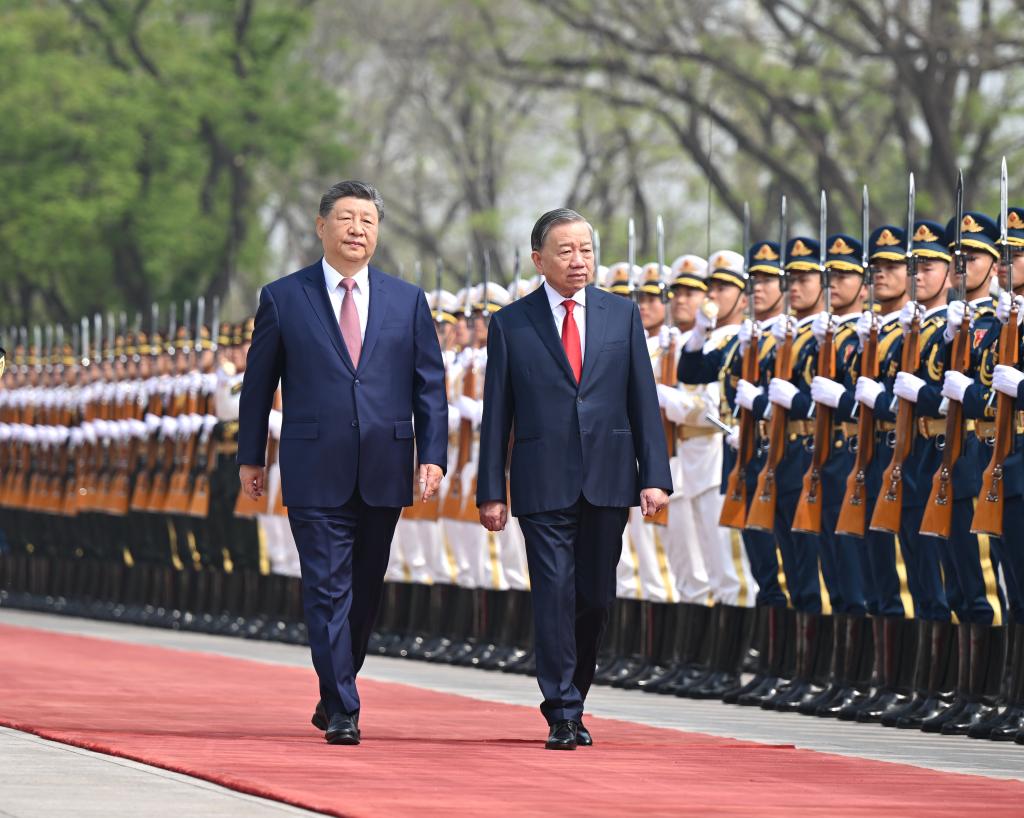
As the world’s eyes remain fixed on the Strait of Hormuz, Beijing has moved to consolidate its external environment through a wave of high-level diplomatic engagements, hosting leaders and representatives from Vietnam, Thailand, Laos, the UAE, Mozambique and Russia. These interactions are about strategic reassurance, stabilizing partnerships, and reinforcing alignment at a time of uncertainty. Within this broader diplomatic push, Vietnamese President To Lam’s four-day state visit mid-April stands out. As his first overseas trip since assuming office, the visit reflects continuity in Hanoi’s foreign policy and a renewed acknowledgement of Beijing’s centrality in Vietnam’s strategic calculus.
Building on the recent “3+3 Dialogue” between the two countries, the timing and outcomes of the visit confirm a growing convergence of interests and a clearer alignment of strategic objectives. The expansion of cooperation across multiple sectors, alongside growing compatibility in foreign policy and economic priorities, and the enduring “comrades and brothers” relationship, reflects a pragmatic affirmation of mutual interest. It indicates that both sides are strengthening bilateral ties for uncertain times, with the relationship likely to evolve through selective convergence informed by their respective national interests.
New Momentum?
President Lam’s visit underscores how head-of-state diplomacy is actively shaping the trajectory of China-Vietnam relations. In his People’s Daily article, To Lam situates bilateral relations within the context of “profound and epoch-making changes”, framing closer engagement with China as a strategic response to global economic and geopolitical shifts. Both leaders emphasize top-level political guidance, expanding sectoral cooperation and people-to-people ties as the three core pillars driving the relationship, suggesting a deliberate effort to institutionalize alignment across multiple domains.
This is reflected in the evolving language of the partnership. During President Xi Jinping's 2025 visit to Hanoi, he described bilateral ties as a “community with a shared future at a higher level,” a formulation that has since been elevated to “accelerating the building of a higher-level China-Vietnam community with a shared future that carries strategic significance”. The shift in phrasing signals greater ambition and strategic depth on both sides. Moreover, Vietnam’s prioritization of China in its foreign policy is evident in President Lam’s description of China as a “strategic choice” and “top priority”. High-level political engagement is accompanied by strategic coordination in development and planning, with Vietnam’s 14th NPC Resolution closely aligning its priorities with China's 15th FYP focus on technology and innovation. Both countries have prioritised science and technology innovation, called for rectification of their political systems, and mentioned new and unprecedented changes in the external environment.
China-Vietnam strategic coordination also takes on cross-border dimensions. President Lam’s engagements in Guangdong and Guangxi highlight his motive to integrate Hanoi with Chinese provincial growth engines. By engaging directly with provincial authorities and businesses in Guangdong, he emphasized attracting high-quality Chinese investment into sectors such as digital transformation, green growth and infrastructure. His visit to Huanghuagang Memorial Park and his study of Guangzhou’s reform-era experience further underline his intention to draw practical lessons from China’s development trajectory in industrialization, openness, and state-led coordination. Moreover, President Lam’s travel to Nanning in Guangxi by high-speed rail underscored his emphasis on connectivity as a driver of economic integration, particularly in linking northern Vietnam more closely with southern China’s industrial and logistics supply chains. Leveraging Vietnam’s role as a gateway between China’s southwest and ASEAN markets, Hanoi is focused on expanding border trade and cross-border industrial linkages. This approach is being institutionalized through mechanisms such as the “early spring meeting” among border provinces.
Alongside connectivity, technology cooperation is emerging as a parallel pillar of the relationship. As Hanoi accelerates its push for digital and technological transformation, President Lam’s visit to Xiong'an New Area, often described as China’s “city of the future”, highlights Vietnam’s interest in learning from China’s urban modernization, digital infrastructure and innovation-led growth. This shift is already visible in the growing presence of Chinese firms, like Victory Giant Technology, Huawei and ZTE, within Vietnam’s high-tech manufacturing and digital infrastructure sectors. Institutionally, this trajectory is being reinforced through formal agreements, including the MoU on information technology and digital transformation signed between the two governments during the visit. Additionally, cooperation is likely to deepen across artificial intelligence, semiconductors and Internet of Things. For Vietnam, the goal is to shift from assembly-based manufacturing to innovation-led growth, while building domestic technological capabilities. For China, supporting Vietnam’s technological advancement serves to extend its supply chains, diffuse its technological standards and consolidate regional innovation ecosystems centered on Chinese firms.
Comrades and Brothers
China and Vietnam enjoy ideological complementarity that enables the realisation of a shared objective; enhancing regime security and building resilience to external shocks and coercion. Reinforcing the political security of the Communist Party of China (CPC) and Communist Party of Vietnam (CPV) is the foundational tenet of the political relationship. Both sides nurture a “brothers and comrades” relationship reinforced through leadership-level strategic security, extensive inter-Party exchanges for coordination and affirmation of ideological and historical ties. The common interest in safeguarding the leadership of the Party was articulated by Xi Jinping during his meeting with To Lam when he said, “defending the socialist system and the ruling position of the communist party is the greatest common strategic interest of the CPC and the CPV”. The underlying threat perception that explains this emphasis is the concern about regime instability from external sources, or worse, color revolutions i.e uprisings in communist/authoritarian countries. It was articulated by Wang Xiaohong, China’s Minister of Public Security, during the 3+3 Dialogue, who argued that political security must be a priority to prevent color revolutions. The shared concern translated into concrete coordination between the respective public security ministries during To Lam’s visit, producing a protocol agreement for a ministerial-level hotline. Coordination for political security is a trust-building mechanism and assurance of alignment on key interests.
Strategic coordination is comprehensively integrated into China’s political relationship with Vietnam and actualized across political and planning bodies at various levels. Both Xi and Lam highlighted inter-Party exchanges, with the joint statement calling for strengthening exchanges between “counterpart departments of the two central committees and local party organisations.... especially in border provinces”. It also applies to the highest leadership bodies on both sides, like the National People’s Congress (NPC), Chinese People's Political Consultative Conference (CPPCC) and Vietnam Fatherland Front. Manifestations of the “comrades and brothers” relationship include the armed forces, who cooperate in areas of political work, training, exercises and border management; the tenth border defense friendly exchange activity held in March 2026 was a clear signal that party and military organs in China and Vietnam are coordinating efforts to safeguard their political systems.
China and Vietnam are also reinforcing a collective identity, underpinned by historical relationships and people-to-people ties. The locations of To Lam’s visit, to Guangzhou and Guangxi in particular, were meant to highlight China and Vietnam’s revolutionary connections. Ho Chi Min’s ties to Guangzhou, and Guangxi’s role as a “rear base” during Vietnam’s independence struggle, were emphasized during To Lam’s meeting with Chen Gang, the Party Secretary of Guangxi. Leveraging such historical ties for collective identity formation is the basis for initiatives like Red Study Groups, created by Xi Jinping and To Lam to create favorable people-to-people ties. Between May 2025 and March 2026, a total of eight themed camps across 10 provincial-level regions in China were organized under the initiative. Forging collective identities and shared ideological outlooks positively influence the political security and strategic coordination envisioned by Beijing and Hanoi.
Cooperation Amid Contestations
China and Vietnam’s expanding trade, supply chain and connectivity linkages, underpinned by robust political ties, are only one-half of a complex bilateral relationship. Deepening political, economic and technological convergence exists alongside enduring strategic frictions and asymmetries. For instance, differing positions on maritime disputes in the South China Sea continue to shape Vietnam’s threat perceptions and defense posture with respect to China. Hanoi’s participation in maritime security initiatives with regional partners in 2025 with 7 regional partners like the Philippines, and its broader balancing of ties with the United States, illustrates its long-standing strategy of “bamboo diplomacy”.
Overall, Vietnam’s foreign policy with China has been characterized as a policy of “cooperation and struggle”, where Hanoi pursues economic integration with Beijing while simultaneously reinforcing external security partnerships with the United States and regional countries to mitigate risks arising from over-reliance on China. For India, Vietnam occupies a pivotal position in its engagement with ASEAN, particularly within the framework of Act East Policy and Indo-Pacific Vision. The fact that President Lam decided to make India his second visit after China signals Hanoi's recognition of New Delhi as a significant regional/strategic partner. His visit to India will present New Delhi an opportunity to offer Hanoi the optionality of strategic hedging to counter its overreliance on China. However, forging deeper India-Vietnam relations will first require addressing the economic realities driving Hanoi’s foreign policy decision-making.
Although Chinese academics argue that territorial disputes and bilateral frictions will not hinder China-Vietnam relations, it is worth remembering that the present uncertainties of global geopolitics have pushed Vietnam and China to accelerate alignment and coordination. The same conditions could also create the necessity for Vietnam to look for strategic balancing options. New Delhi can leverage such an opportunity to advance its Act East Policy objectives and build stronger ties in a region moving quickly into China’s economic and diplomatic orbit.
Image Credit: Xinhua
Author
Rahul Karan Reddy
Rahul Karan Reddy is Senior Research Associate at Organisation for Research on China and Asia (ORCA). He works on domestic Chinese politics and trade, producing data-driven research in the form of reports, dashboards and digital media. He is the author of ‘Islands on the Rocks’, a monograph on the Senkaku/Diaoyu island dispute between China and Japan. He is the creator of the India-China Trade dashboard, the Chinese Provincial Development Indicators dashboard and co-lead for the project ‘Episodes of India-China Exchanges: Modern Bridges and Resonant Connections’. He is co-convenor of ORCA’s annual conference, the Global Conference on New Sinology (GCNS) and co-editor of ORCA’s daily newsletter, Conversations in Chinese Media (CiCM). He was previously a Research Analyst at the Chennai Center for China Studies (C3S), working on China’s foreign policy and domestic politics. His work has been published in The Diplomat, 9 Dash Line, East Asia Forum, ISDP & Tokyo Review, among others. He is also the Director of ORCA Consultancy.
Ophelia Yumlembam
Ophelia Yumlembam is a Research Associate at the Organisation for Research on China and Asia (ORCA). Before joining ORCA, she worked at the Dept. Of Political Science, University of Delhi, and interned at the Council for Strategic and Defence Research in New Delhi. She graduated with an M.A. in Political Science from the DU in 2023. Ophelia focuses on security and strategic-related developments in Myanmar, India's Act East Policy, India-Myanmar relations, and drugs and arms trafficking in India’s North Eastern Region. Her writings have been featured in the Diplomat, South Asian Voices (Stimson Centre), 9dashline, Observer Research Foundation, among other platforms.