
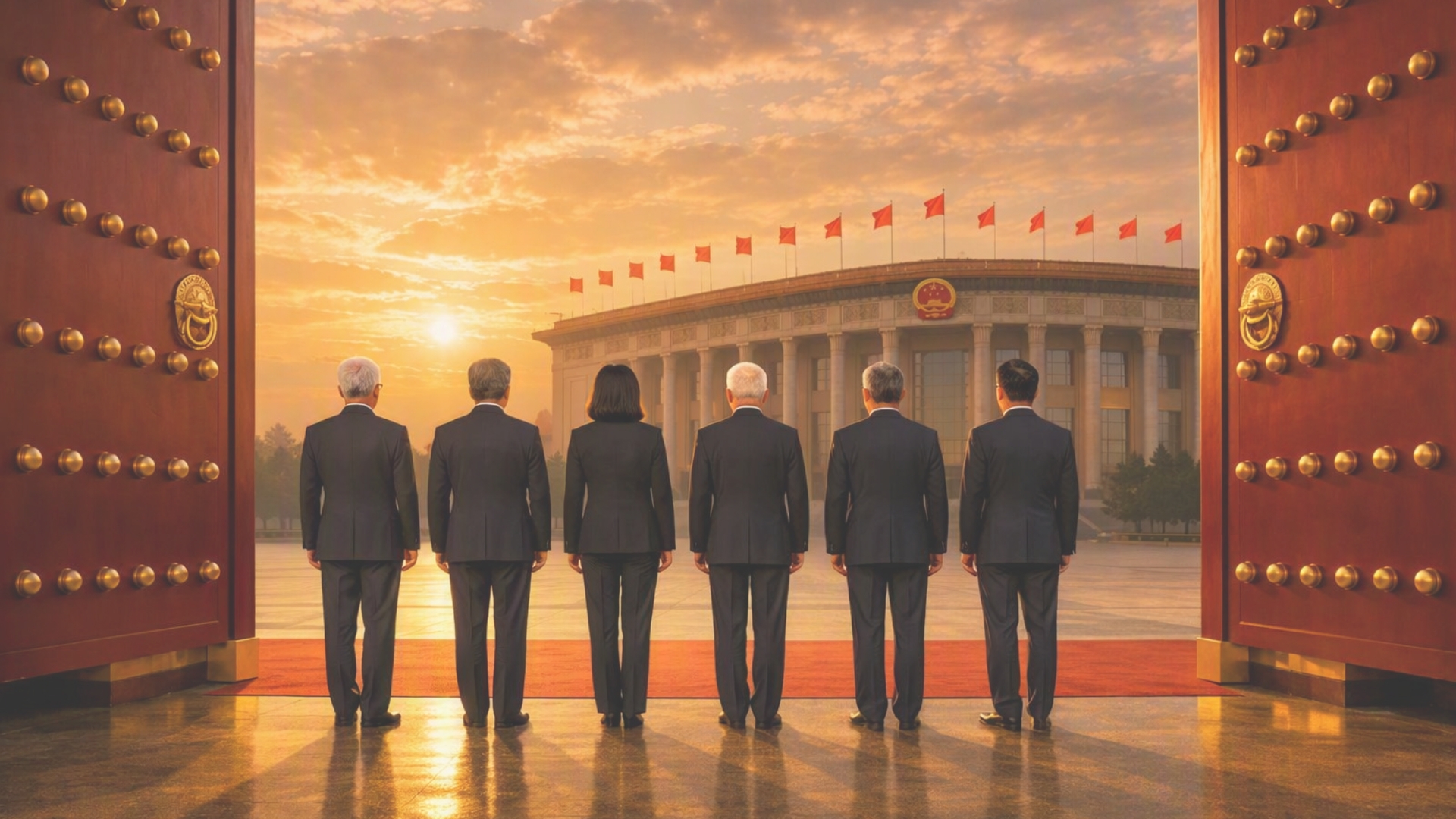
With just over a year to go before the 21st Party Congress, the annual gathering of senior leaders at Beidaihe is an important window into developments in China’s elite politics. The informal summer gathering has commonly been understood as an occasion for bargaining and signalling by leaders. However, the unparalleled authority of Xi Jinping within the Party and diminished role of rival factions and Party elders has rendered this particular function less effective than in recent years.
Nonetheless, reshuffles of various provincial leaderships in the run-up to and following Beidaihe offer clues about the direction of change in China’s political system. They indicate which officials have the potential for national-level leadership, and may be moved into strategically important provincial positions, thus allowing them to accumulate administrative experience and demonstrate their suitability for higher office. Following the Politburo meeting on July 30 and Standing Committee meetings of various Provincial and Municipal People’s Congresses, new appointments are laying the groundwork for a new Central Committee, Politburo and Standing Committee in 2027.
Apex of Provincial Leadership
The most notable reshuffle was announced in Hebei, a strategically important province that hosts Beidaihe and is home to Xiong’an New Area, just days before the informal gathering. Luo Wen (罗文) was appointed Party Secretary, replacing Ni Yuefeng (倪岳峰), an elevation for Luo who was Director-General and Party Secretary of the State Administration for Market Regulation (SAMR) for the last four years. The move to Hebei deepens Luo’s provincial leadership credentials after a stint in Sichuan as Executive Vice Governor from March 2020 to June 2022. This would be the second time Luo has been transferred from a central government position in Beijing to a provincial role. At 61, his elevation to the highest leadership role in Hebei, and expertise in the internet and information industry, could pave the way for further elevation at the provincial level just before or after the Party Congress. As for Ni Yuefeng, his next appointment after a 4-year stint in Hebei is worth watching closely.

Luo Wen
Another notable appointment is that of Kong Shaoxun (孔绍逊), as Governor and Deputy Party Secretary of Gansu, replacing Ren Zhenhe (任振鹤). Kong was famous for escorting Hu Jintao out of the 20th Party Congress, and worked closely with Ding Xuexiang as Director of the Personnel Bureau of the General Office of the Central Committee for over a decade. Kong at 59 is now a full provincial/ministerial-level official, but neither a Central Committee member nor a CCDI member, and is likely to be elevated to the Central Committee at the 21st Party Congress. Like Kong, Zhu Zhongming (朱忠明), who is neither a Central Committee member nor a CCDI member, has been appointed to Shanghai as Mayor, replacing Gong Zhen. Although recent Shanghai mayors have not risen to national leadership, Zhu’s age (54), connection with Li Qiang and background as a finance official positions him well at least for a Central Committee membership.


Kong Shaoxun and Zhu Zhongming
Climbing the Ladder
The rotation of officials follows a pattern of reconfiguration, wherein leadership teams are adjusted to prevent the creation of entrenched networks and cultivate administrative talent. From this process of reorganisation, candidates with suitable credentials are presented with opportunities for upward political mobility, and emerge as prospects for higher office. This is particularly true for a few recently-appointed 1970s-generation leaders who can fill the large number of vacancies in the Central Committee.
Liu Qiang (刘强) and Hu Guangjie (胡广杰), for instance, are 1970s-generation leaders who boast extensive sectoral expertise, were responsible for military affairs and have already worked in provinces or the central government in Beijing. Liu has been appointed Deputy Party Secretary of Shandong after climbing the ranks for 6 years in Shandong, since his appointment as Vice Governor in 2018. Liu is concurrently the Party Secretary of Jinan, which has been a promising channel for political mobility; Wang Wentao (王文涛), China’s Minister of Commerce, and former Hubei Party Secretary, Wang Zhonglin (王忠林), have been the previous Party Secretaries of Jinan. With a decade of expertise at the intersection of banking and agriculture and experience as the First Secretary of the Jinan Garrison Command, Liu is a potential candidate for full membership of the Central Committee. Hu Guangjie, was previously in Jiangsu as the youngest member of the Party Standing Committee and operated as head of the United Front Work Department. His age, background in petroleum engineering, cross-provincial experience and multiple appointments in Guizhou as Party Standing Committee member, Vice-Governor and Director of the Provincial Commission for Military-Civilian Integration Development, position him well for further elevation, perhaps as Alternate member of the Central Committee.


Liu Qiang and Hu Guangjie
Searching for Stability in Jiangxi and Chongqing
Personnel reshuffles in the build-up to Beidaihe demonstrated that appointments are likely to be made with stability in mind, especially in regions with leadership investigated for corruption or other performance issues. In Chongqing, Chen Xinwu (陈新武) was appointed Mayor after working closely with Yuan Jiajun as Executive Mayor in Chongqing. Although Chen isn’t a Central Committee or CCDI member, his appointment as Acting Mayor, following former Mayor Hu Henghua’s investigation, indicates that the search for a stabilising appointment in Chongqing may be complete. Furthermore, Tan Quan (谭全) was announced as Vice Mayor and head of Public Security in Chongqing, taking over after the death of former police chief Zhang Anjiang.
In Jiangxi too, the reshuffle of Zhang Ying (张英) from Vice Governor to head of the provincial United Front Work Department (UFWD) has underscored the churn in provincial leadership. Jiangxi Governor, Ye Jianchun (叶建春) has been placed under investigation in August and several senior Jiangxi leaders like Chen Min, Wang Aihe and Yin Jianye have been removed in the last few months. Future appointments to the senior leadership in Jiangxi are likely to be made with the objective of restoring stability and political security.


Zhang Ying and Ye Jianchun
Overall, personnel reshuffles at the provincial level, made just before and after Beidaihe, are only indicative of which officials are positioned appropriately for entry into the Central Committee. With the Fifth Plenum of the Central Committee in October 2026 and the Party Congress a year away, more vacancies are likely to open up as Central Committee members are purged or investigated for corruption. As a result, leadership turnover at the provincial level could involve more leadership positions and a greater number of candidates, who will contest for promising appointments.
Author
Rahul Karan Reddy
Rahul Karan Reddy is Senior Research Associate at Organisation for Research on China and Asia (ORCA). He works on domestic Chinese politics and trade, producing data-driven research in the form of reports, dashboards and digital media. He is the author of ‘Islands on the Rocks’, a monograph on the Senkaku/Diaoyu island dispute between China and Japan. He is the creator of the India-China Trade dashboard, the Chinese Provincial Development Indicators dashboard and co-lead for the project ‘Episodes of India-China Exchanges: Modern Bridges and Resonant Connections’. He is co-convenor of ORCA’s annual conference, the Global Conference on New Sinology (GCNS) and co-editor of ORCA’s daily newsletter, Conversations in Chinese Media (CiCM). He was previously a Research Analyst at the Chennai Center for China Studies (C3S), working on China’s foreign policy and domestic politics. His work has been published in The Diplomat, 9 Dash Line, East Asia Forum, ISDP & Tokyo Review, among others. He is also the Director of ORCA Consultancy.
Neha Maurya
Neha Maurya is a Project Assistant at Organisation for Research on China and Asia (ORCA). A recent graduate of FLAME University with a major in International Studies and a minor in Public Policy, her research interests include strategic studies, governance, and education policy. She is interested in contributing to research that informs effective policy design and implementation.