
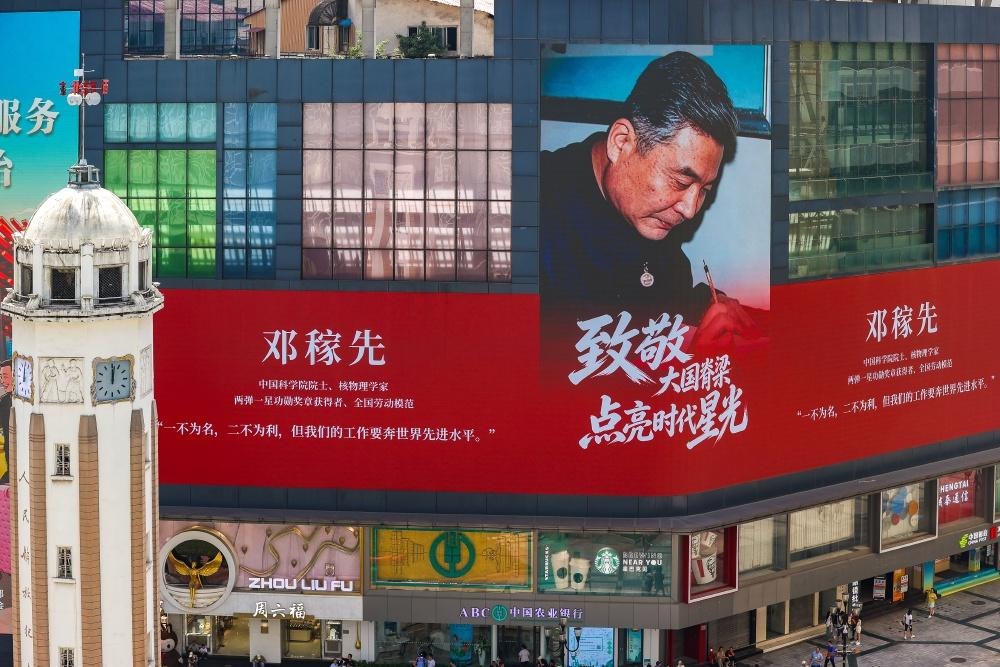
In Chinese malls and metro stations across multiple provinces and cities, digital advertising screens are being used to showcase the faces of scientists, occupying spaces more commonly associated with luxury brands, celebrities, new technology and other consumer products. When a portrait of nuclear physicist Deng Jiaxian appeared on a commercial billboard in Chongqing’s Jiefangbei district, it attracted more than 20,000 likes on Douyin after Chongqing Daily shared the image online. The display was part of a wider campaign in which shopping centres and metro stations across China gave prominent advertising space to scientists such as Qian Xuesen, Deng Jiaxian, Yuan Longping and Tu Youyou, presenting them as figures worthy of the same public visibility usually reserved for celebrities and commercial brands. Rather than promoting a product, these screens promote an ideal of scientific achievement as something worthy of public recognition and personal aspiration. The campaign has also received endorsement from senior Chinese officials, giving what might otherwise appear to be a public-awareness initiative a more explicit political dimension.
Chinese Ambassador to the United States, Xie Feng, highlighted the campaign on social media, drawing attention to scientists such as Yuan Longping and Tu Youyou. In describing these scientists as “the true stars we should be looking up to”, Ambassador Xie elevated scientific achievement as a model of success and aspiration. His description of scientists resonates with the Chinese expression “these are the stars we should really be following” (这才是我们最该追的星). The phrase plays on 追星 (chasing stars), the common Chinese term for idolising celebrities, recasting scientific achievement and service to society as worthier objects of public admiration. The campaign comes at a time when China is reshaping its economy and higher education around technological development. Artificial intelligence, semiconductors, biotechnology, advanced manufacturing, quantum technologies and aerospace have become central to Beijing's economic and geopolitical ambitions. Universities are being encouraged to expand programmes in these fields, while national policy has repeatedly linked the cultivation of scientific and technical talent to technological self-reliance and national development.
In this context, putting scientists on public billboards is part of an attempt by the Communist Party of China (CPC) to shape the aspirations of the next generation and to align individual ambitions with national priorities. By placing scientists in high-visibility commercial districts, transport spaces and other public settings, the displays make China's scientific achievements part of the everyday visual landscape of its cities, where they can be circulated beyond their immediate audiences through social media campaigns. Ambassador Xie Feng's amplification of the campaign on social media extends this narrative into international discourse, projecting an image of China whose national prestige rests on technological advancement furthered by scientific contributions.
From National Icons to Global Ambitions
The billboards are thus part of an effort to give Chinese scientific and technological expertise greater social and political value. The particular figures chosen for these campaigns reveal the values that China seeks to attach to scientific achievement. Qian Xuesen and Deng Jiaxian are central figures in the history of China’s “Two Bombs, One Satellite” programme, which official narratives associate with breaking the country’s dependence on foreign powers, strengthening national defence and raising China’s international standing. Yuan Longping’s work on hybrid rice is similarly linked by Chinese state institutions to the consolidation of national food security and agricultural development, while Nobel laureate Tu Youyou’s discovery of artemisinin is presented as both a major achievement of Chinese science and a contribution to global health that has benefited millions of people. Their accomplishments frame scientific achievement as a response to national challenges, with innovation strengthening China domestically and enhancing its standing internationally.
China is now extending this logic beyond its borders, linking the cultivation of technical talent at home with its ambitions for technological cooperation across the Global South. At the 18th BRICS Summit in New Delhi in September 2026, President Xi Jinping proposed a BRICS “science and technology talent cultivation” initiative that includes establishing a BRICS Engineers Training Alliance, jointly training engineers and working towards mutual recognition of professional competency standards. China also proposed a youth science and innovation exchange programme aimed at cultivating high-level scientific and technological talent. This focus on scientific talent abroad is also mirrored in the way scientific achievement is elevated within China.
Reshaping the Knowledge Economy
China’s drive to build technological capacity extends from shaping public attitudes towards science to reorganising the institutions that produce scientific expertise. By elevating science in everyday public life, these initiatives help establish scientific achievement as a socially valued form of success, reinforcing the cultural conditions for a workforce that is orientated towards technological development. National laws like the 2024 revised Science and Technology Popularisation Law (中华人民共和国科学技术普及法) explicitly call on public spaces, including shopping malls and transport hubs, to carry out science popularisation activities. The revised law was followed by the launch of China’s first National Science Popularisation Month in 2025, with the second edition taking place this September. These campaigns also accompany a state-led restructuring of Chinese higher education around national economic and technological priorities. In April 2025, universities added 1,839 undergraduate programme sites, while cancelling 1,428 and suspending admissions to 2,220. Universities are therefore being asked to anticipate the skills and areas of expertise that China’s future economy will require, rather than simply responding to existing patterns of student demand or employment.
The Higher Education Discipline and Programme Adjustment and Optimisation Action Plan 2025-2027, issued by the Central Education Work Leading Group in August 2025, takes this approach further. It calls for technological development and national strategic requirements to guide the adjustment of university disciplines, while encouraging the use of artificial intelligence to update existing fields and establishing new platforms such as the National Excellent Engineers Academy. Education policy consequently operates alongside industrial and talent policy, with universities serving as state-led institutions that direct human resources towards strategically important areas.
The language of these policies is significant because it places different academic fields within a hierarchy determined partly by their relationship to national development. Disciplines associated with strategic emerging industries are to be established rapidly, while programmes judged to have insufficient social demand can face warnings and rectification. This does not amount to a simple abandonment of the humanities in favour of science and technology, particularly because the 2025-2027 Action Plan also calls for interdisciplinary development. It does, however, show a clear shift towards a higher education system where the state shapes education around future economic and technological needs.
The Drive for Kējì Zìlì Zìqiáng (科技自立自强)
US restrictions on advanced semiconductors and manufacturing equipment have highlighted how China’s ambitions in high-tech industries remain vulnerable to decisions made beyond its borders. In December 2024, the US Bureau of Industry and Security expanded controls on semiconductor manufacturing equipment, software tools and high-bandwidth memory, further limiting China's access to technologies used in advanced chip production. Without access to extreme ultraviolet (EUV) lithography machines, Chinese companies are forced to rely on deep ultraviolet (DUV) technology and multiple patterning, a more complex process for producing chips at this scale. The significance for Beijing is therefore not simply that foreign technology can be withheld, but that access to a small number of specialised tools can affect the cost, scale and pace at which domestic innovation becomes commercially viable. At the same time, public perceptions of technological self-reliance are shaped by how the government frames scientific challenges and the prospect of overcoming them. A comment under an article on China’s semiconductor ambitions stated, “Given China’s history of developing ‘Two Bombs, One Satellite’, it’s easy to imagine that China will inevitably overcome the challenges of chip manufacturing processes on its own; it’s just a matter of time”. Science popularisation advertisements echo this state-led narrative of national perseverance, framing scientists’ achievements as contributions to national progress despite external constraints.
The 15th Five-Year Plan responds directly to this environment by aiming for kējì zìlì zìqiáng ( 科技自立自强), or scientific and technological self-reliance. It calls for breakthroughs in critical technologies and identifies areas including integrated circuits, advanced materials, biomanufacturing, artificial intelligence, quantum technology, robotics, aerospace and 6G as priorities. These sectors offer more than commercial potential; China sees them as crucial to future industrial competitiveness and strategic power. The pursuit of these capabilities is closely tied to the question of who will develop them and how Beijing will build the expertise required to do so. Ambassador Xie Feng’s framing of the 15th Five-Year Plan reinforces this connection, linking the “integrated development of education, science and technology and talent” to breakthroughs in core technologies and arguing that neither the US’ “small yard, high fence” approach nor decoupling and supply-chain disruption will prevent China from advancing internationally.
In this manner, knowledge production and the production of technological capacity are being brought within the same policy framework, with public campaigns raising the prestige of scientific work, university reforms channeling students towards strategically important skills, and international initiatives extending these priorities through cooperation in engineering and AI development. The scientist on the billboard becomes a cultural symbol of this process, placing scientific expertise alongside celebrities and brands that usually define public visibility. This gives scientific work a particular social meaning, linking knowledge with nationalist sentiment and service. Together, these measures link the cultivation of individual aspirations to China’s international strategy, allowing the state to promote technological capacity as part of its vision for development across the Global South.
Image Credits: Chongqing Daily
Author
Chitra Nair
Chitra Nair is a postgraduate in Chinese Studies from SOAS University of London, holding a bachelor’s degree in International Relations with a minor in Environmental Studies from FLAME University, India. Her research explores contemporary Chinese politics, digital activism, political expression and censorship. She is especially interested in how the state and citizens negotiate power and legitimacy, questions which she seeks to explore through a political sociology lens. She previously interned at the Institute of Chinese Studies, New Delhi, where she published work on media censorship and the queer community in China. Her dissertation, Digital Panopticon : Activism and State Surveillance in China, examines digital activism and censorship in China through three key case studies.