
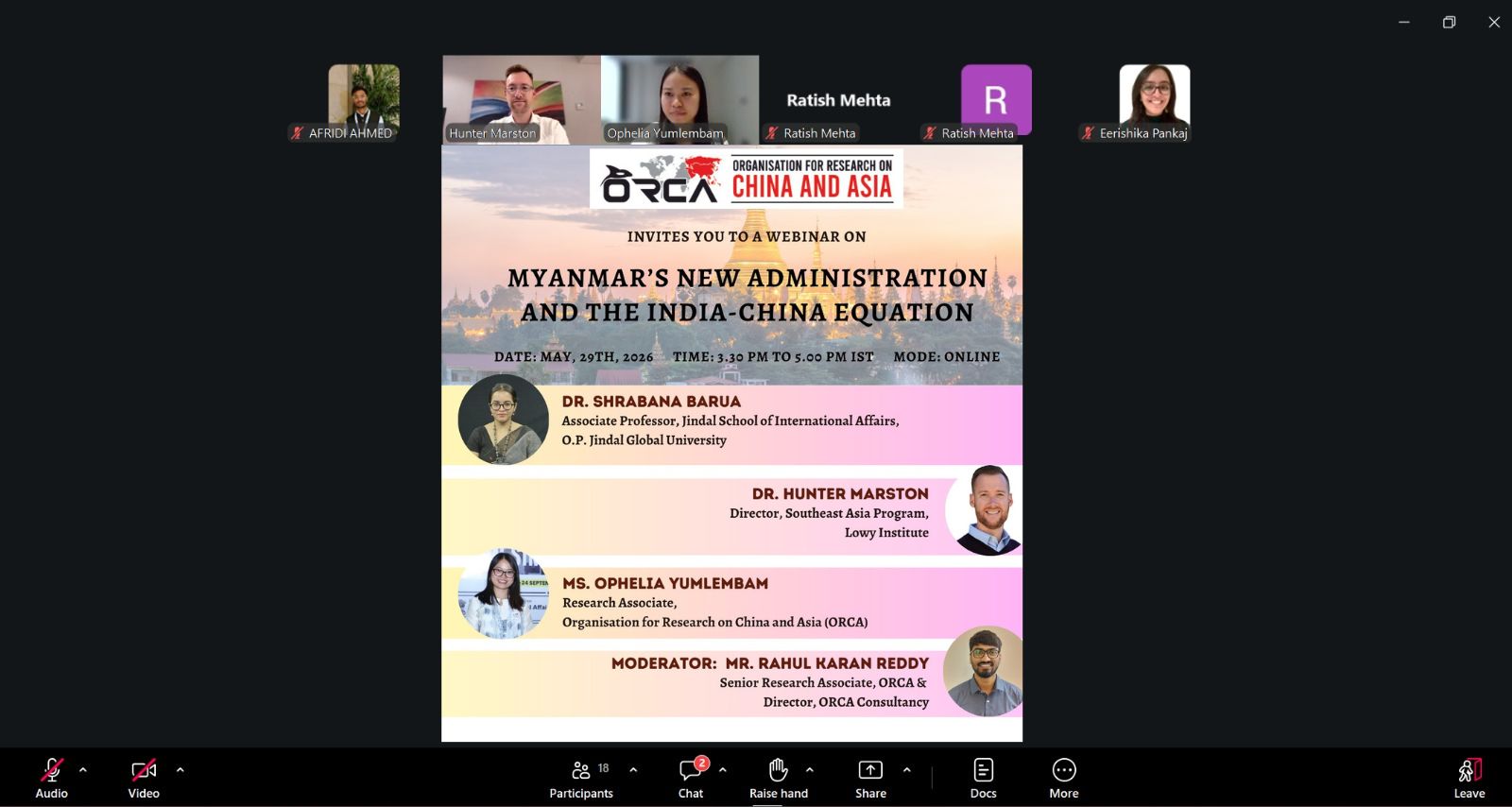
Organisation for Research on China and Asia hosted a webinar discussion on “Myanmar’s New Administration and the India-China Equation." The session was moderated by Senior Research Associate Mr. Rahul Karan Reddy, featuring Dr. Shrabana Barua, Dr. Hunter Marston, and Ms. Ophelia Yumlembam as discussants.The discussion examined what a new administration in Myanmar means for India and China, and how Naypyidaw may revisit its foreign policy playbook.

Dr. Shrabana Barua argued that India’s influence in Myanmar is not diminishing, though it cannot match China’s investment scale. She highlighted defense cooperation and projects like Kaladan as key pillars of India’s approach. She also noted that Beijing does not exercise full control over all actors in Myanmar, particularly EAOs, creating space for India to adopt a dual engagement strategy with both state and non-state actors.

Dr. Hunter Marston challenged the “isolation” narrative, arguing that Myanmar remains externally engaged. However, he emphasized that China’s economic dominance—through trade, investments, and extractive industries—limits any realistic replacement by India. He argued that despite India’s relative strength in diplomatic and defense outreach, Myanmar’s leadership is likely to continue hedging between India and China, reflecting a strategy of calibrated balancing rather than alignment.

Ms. Ophelia Yumlembam argued that China’s dual-track engagement in Myanmar has not translated into broader influence; instead, it has contributed to growing anti-China sentiment across the country. She noted that Beijing’s leverage remains largely concentrated within the military regime and a limited number of EAOs. She further observed that key projects under BRI and CMEC are likely to continue facing challenges, as the corridor passes through regions beyond the junta’s effective control.

Moderator Mr. Rahul Karan Reddy steered the debate towards key questions on China’s political leverage, India’s infrastructure priorities and whether the new administration would balance major powers amid regional dynamics involving ASEAN.

The session concluded with an engaging Q&A, addressing India’s border security priorities, ASEAN’s response to Myanmar’s reintegration, Russia’s role in Naypyitaw and whether the new administration can balance India–China ties or remains structurally dependent on Beijing, alongside questions on the relevance of the “pauk-phaw” narrative.