
Myanmar's new President and former military junta chief, Min Aung Hlaing, undertook a five-day state visit to China from 15th–19th June. The trip marked his second overseas state visit since assuming office and his first visit to China as head of Myanmar’s new government. The visit attracted considerable attention because, contrary to widespread expectations that Beijing would be his first post-election destination, Min Aung Hlaing had instead chosen New Delhi for his inaugural state visit. Given Myanmar's long-standing dependence on China for economic assistance, diplomatic backing and military cooperation, the decision was widely interpreted as an attempt by the new administration to diversify its foreign policy and reduce perceptions of excessive reliance on Beijing.
The Beijing visit was therefore closely watched for insights into Myanmar's approach towards Beijing under the new administration and Beijing's strategy for engaging with the country's post-election political landscape. As one of the key neighbours of Myanmar, Beijing has sought to recalibrate its engagement to safeguard its long-term interests amid a changing domestic political context. This makes the timing of the visit particularly significant, raising important questions about what it reveals regarding the changing dynamics of China–Myanmar relations. More fundamentally, what do Beijing's diplomatic, institutional, and symbolic support suggest about its long-term strategic objectives in Myanmar?
Beijing's Recognition of the Post-Election Order
The most significant outcome of Min Aung Hlaing's visit was the reaffirmation of China's role as the new administration's principal diplomatic patron. At a time when the regime continues to face questions over its legitimacy from Western governments and international institutions, securing external political backing remains a key foreign-policy objective for Naypyidaw. Since the formation of the new administration following the regime's orchestrated election, Beijing has been among the first major powers to publicly engage with and express support for the new government. China's support is particularly consequential as it can help the Myanmar government advance its efforts to normalise relations with regional and multilateral institutions.
Beijing's willingness to actively champion Myanmar's reintegration into regional and multilateral institutions was clearly evident in Xi Jinping's backing of Myanmar's “full, equal, and constructive participation” in ASEAN and United Nations processes underscored China's role as the junta's principal diplomatic patron. The statement directly aligned with one of Min Aung Hlaing's central foreign-policy objectives of normalising relations with ASEAN, which he highlighted during his swearing-in ceremony. The backing also shows that Beijing's support extends beyond symbolic recognition as by advocating Myanmar's inclusion in regional and multilateral institutions, and pledging to safeguard its “legitimate rights and interests”, China is actively facilitating the regime's diplomatic rehabilitation. At a time when the regime's political legitimacy remains widely contested, such backing helps shape the external environment in which Naypyidaw seeks to normalise its political status and re-engage with.
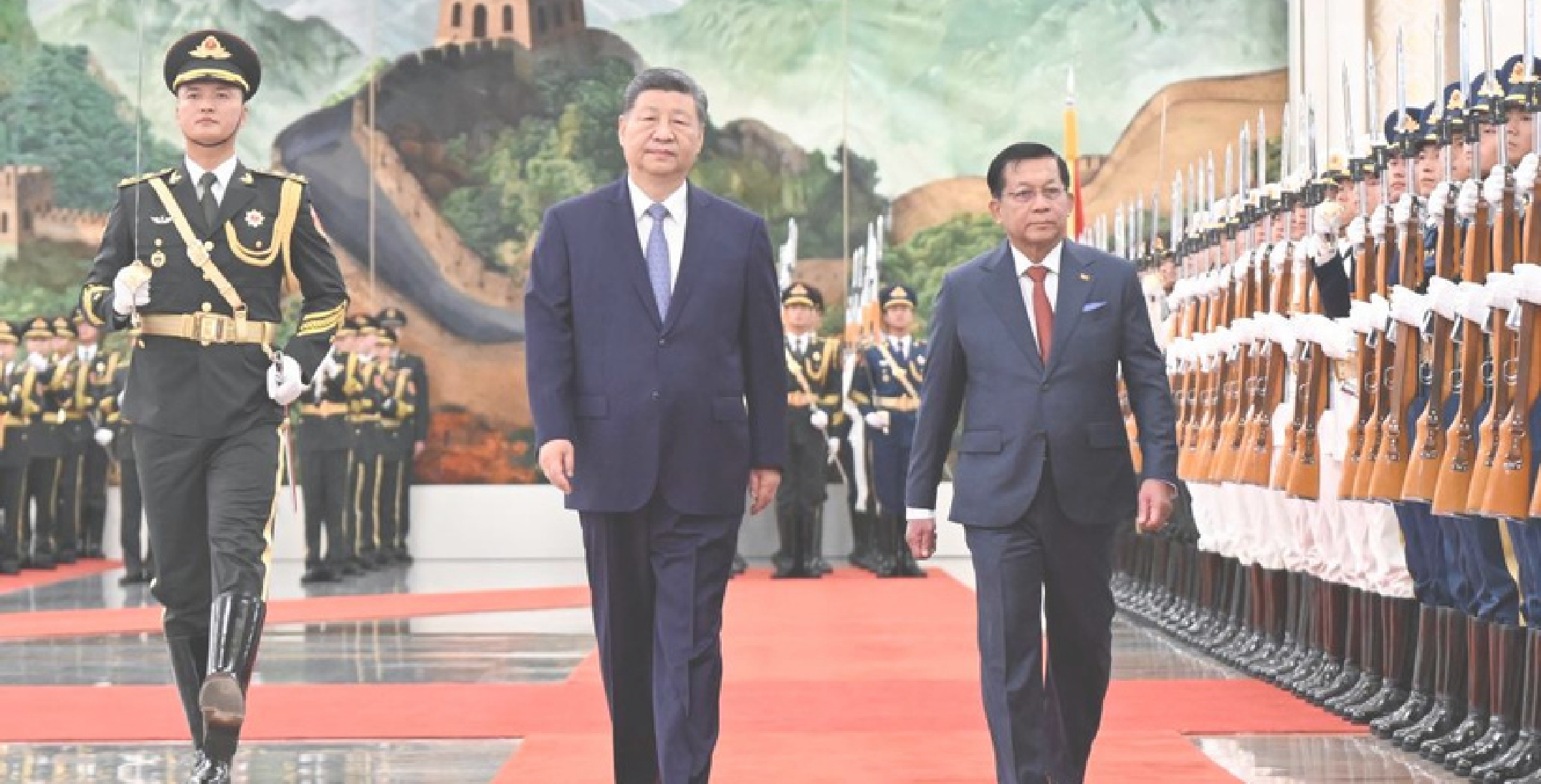
Moreover, China complemented its diplomatic backing with high-level ceremonial honours that carried significant political symbolism. The rare 21-gun salute accorded to Min Aung Hlaing - the highest ceremonial military honour China extends to visiting foreign leaders - was particularly noteworthy. The salute, together with the playing of national anthems in Tiananmen Square and an inspection of the People's Liberation Army Honour Guard functions as a key instrument of diplomatic signalling. By extending these honours, Beijing publicly conveyed the importance it attaches to its relationship with Myanmar's military leadership, reinforced the strength of bilateral ties, and conferred a degree of diplomatic legitimacy on the new administration through the optics of full state protocol. Equally significant were Min Aung Hlaing's meetings with China's senior leadership Foreign Minister Wang Yi, Premier Li Qiang, and Chairman of the Standing Committee of the National People's Congress Zhao Leji — which collectively signalled Beijing's willingness to engage the junta at the highest political levels and treat it as Myanmar's effective representative in bilateral and international affairs.
In return for diplomatic backing and assistance in restoring its regional standing, Myanmar has reaffirmed support for several core Chinese interests. Beyond reiterating its commitment to the One-China principle and support for Beijing's positions on Taiwan, Hong Kong, Xinjiang and Tibet, Myanmar also deepened its engagement with China's emerging global initiatives. The visit therefore highlighted a growing convergence of interests in which Chinese diplomatic support is increasingly accompanied by Myanmar's political alignment with Beijing's regional and international agenda.
Institutionalising China's Long-Term Influence in Myanmar
Security cooperation has traditionally constituted a core component of China–Myanmar relations, with both sides continuing to prioritise cooperation against online gambling, telecom fraud and other transnational criminal activities. However, the 18 agreements signed in Beijing suggest that China's interests in Myanmar are increasingly extending beyond traditional economic and security concerns. Instead, China appears to be pursuing a strategy aimed at integrating Myanmar into a broader ecosystem of Chinese-led institutions, initiatives, and governance mechanisms.
This broader objective was reflected in the signing of an MoU on jointly advancing the Global Security Initiative (GSI), which Xi Jinping noted would facilitate the exploration of a China-Myanmar security partnership and strengthen security cooperation for Belt and Road projects. It was further reinforced by Myanmar's participation in China-led platforms such as the Group of Friends of the Global Development Initiative (GDI) and the Group of Friends of the Global Governance Initiative (GGI). These initiatives signal Myanmar's growing integration into institutions that promote Beijing's preferred principles of international order, including sovereignty, non-interference, and development-first governance, while providing alternatives to Western-led multilateral frameworks. By drawing Myanmar into these governance frameworks, China is seeking not only to deepen bilateral cooperation but also to cultivate support for an international order increasingly shaped by Chinese norms, institutions and strategic preferences.
Among the less-noticed agreements were MoUs on the China-led Global South Media and Think Tank Forum and on expanding cooperation in broadcasting, television and digital audiovisual services. The expanded cooperation follows recent exchanges between Cao Shumin, deputy head of the CCP Central Committee’s Publicity Department and director of the National Radio and Television Administration with Myanmar’s Information Ministry. These initiatives indicate Beijing's broader efforts to shape narratives surrounding its role in Myanmar and strengthen institutional linkages with local information ecosystems. Such efforts are particularly significant given the persistence of anti-China sentiment within Myanmar, especially in areas affected by Chinese-backed infrastructure, resource extraction projects and Beijing's perceived support for successive governments in Naypyidaw. Expanding cooperation with Myanmar's media institutions and think tanks therefore appears aimed at improving China's image, amplifying favourable narratives, and building longer-term influence within the country's information ecosystem.
Moreover, this year marks the launch of China's 15th Five-Year Plan for economic and social development, which Xi Jinping used as an opportunity to signal Beijing's willingness to share its governance and development experience with Myanmar as part of building a "China-Myanmar community with a shared future". Given Myanmar's deepening economic crisis since the 2021 coup and nearly half of the population currently living below the poverty line, China's offer of development expertise and economic planning models aligns closely with the government's pressing developmental and economic challenges. While such cooperation may help address some of Myanmar's developmental challenges, it also advances Beijing's broader objective of promoting Chinese governance and development approaches abroad.
Reading Between the Lines
The most revealing aspect of the visit was what was absent from the agreements and official statements: a renewed push for Chinese investments. Even as both sides emphasised economic cooperation, trade promotion, and future opportunities, there was little indication of investment support. This may be because many strategically important Chinese-funded CMEC projects remain vulnerable to armed conflict, political instability and contested territorial control. Beijing's repeated emphasis on advancing projects "steadily" and under conditions of "safety and security" reflects an acknowledgement of these constraints. Rather than signalling a new phase of economic expansion, the outcomes of the visit suggest that China's immediate priority is to create the political and security conditions necessary for projects already under development to move forward.
Equally notable was the absence of any mention of defence cooperation during the visit. This omission is striking given that China has remained one of Myanmar's largest suppliers of military equipment since the 2021 coup. The absence of any public reference to defence cooperation may reflect Beijing's desire to avoid the political costs of an overt military alignment with Naypyidaw. Given persistent Western criticism of China's alleged support for the Tatmadaw through arms transfers, publicly highlighting defence ties would risk further damaging China's international image. Another possibility is Myanmar's growing reliance on Russia as its primary defence partner. While China continues to supply reliable light combat aircraft and armoured vehicles, the junta has increasingly turned to Russia for more advanced offensive capabilities, reportedly reflecting greater confidence in Russian high-end military hardware as compared to Chinese-made ground vehicles and tanks.
Therefore, the visit revealed the emergence of a transactional political bargain at the centre of contemporary China-Myanmar relations. It reveals a gradual recalibration in which diplomatic support, political alignment and participation in Chinese-led initiatives are becoming as important as traditional economic and security cooperation. How durable this bargain proves to be will depend not only on developments within Myanmar but also on China's ability to balance its long-term strategic ambitions with the realities of a deeply fragmented and conflict-affected neighbour.
Image Credit: Xinhua
Author
Ophelia Yumlembam
Ophelia Yumlembam is a Research Associate at the Organisation for Research on China and Asia (ORCA). Before joining ORCA, she worked at the Dept. Of Political Science, University of Delhi, and interned at the Council for Strategic and Defence Research in New Delhi. She graduated with an M.A. in Political Science from the DU in 2023. Ophelia focuses on security and strategic-related developments in Myanmar, India's Act East Policy, India-Myanmar relations, and drugs and arms trafficking in India’s North Eastern Region. Her writings have been featured in the Diplomat, South Asian Voices (Stimson Centre), 9dashline, Observer Research Foundation, among other platforms.