
Summary
China’s pursuit of nuclear weapons emerged from its leaders’ concerns over U.S. nuclear threats and the vulnerability of the newly established PRC during the Korean War and Taiwan Strait crises. Initially dependent on Soviet assistance, China received significant support in nuclear technology, infrastructure and expertise, culminating in the 1957 Sino-Soviet agreement on nuclear cooperation. However, the deterioration of Sino-Soviet relations and Moscow’s withdrawal of promised assistance in 1959 compelled Beijing to pursue an indigenous programme, codenamed Project 596. Despite the economic pressures of the Great Leap Forward and the loss of Soviet support, Chinese scientists developed the technical capacity to produce highly enriched uranium and successfully assembled an implosion-type device. The successful nuclear test on October 16, 1964, demonstrated China’s ability to overcome technological and material constraints and established it as the fifth nuclear-armed state, while underscoring the strategic importance Beijing attached to nuclear weapons as a means of deterring external coercion and nuclear blackmail.
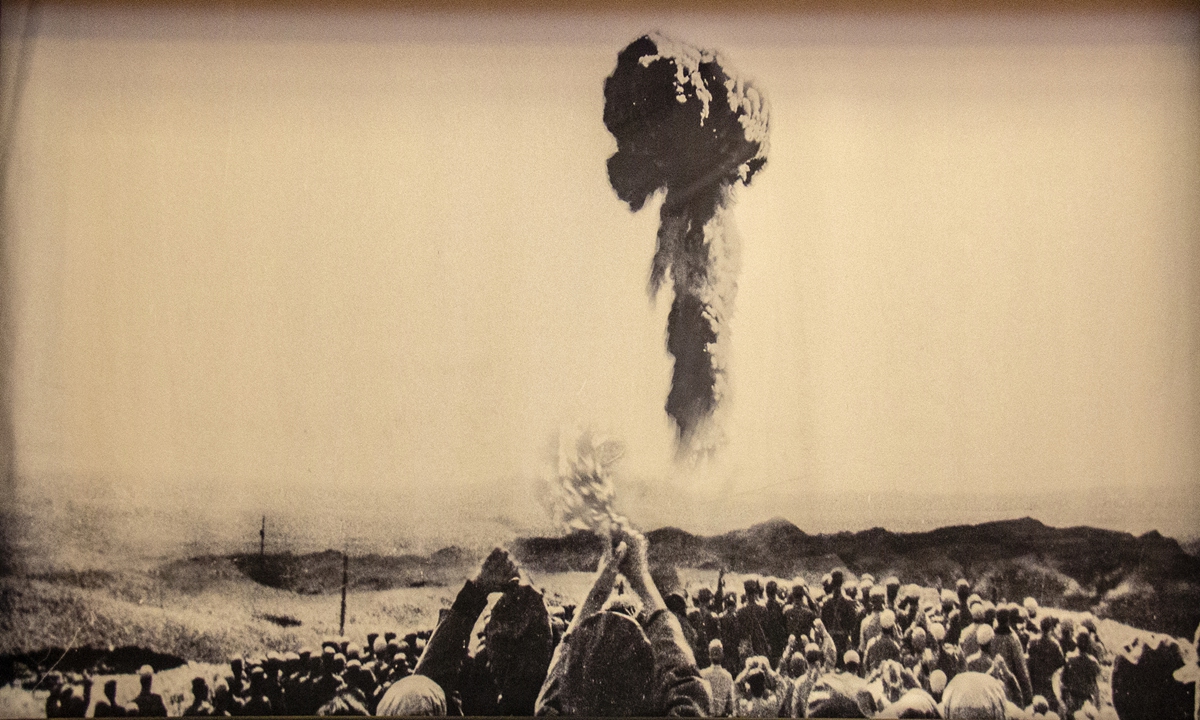
On October 16, 1964, China detonated its first nuclear weapon in the Xinjiang desert near the oasis of Huangyanggou, 150 kilometers northwest of the Lop Nur marshes. The test marked a historic feat for a leadership then celebrating its fifteenth anniversary in power. With this, China joined the United States of America, Soviet Union, France and Great Britain as one of the five atomic powers. It took China less than ten years to produce a working nuclear weapon.
The Spectre of Nuclear Blackmail
China's decision to build the atomic bomb had its roots in a fear born years before the program itself existed. When America alone had the atomic bomb, Mao Zedong and Party leadership feared possible America’s nuclear intervention in the China’s Civil War. When Mao visited Stalin in December 1949 to negotiate China's entry into the USSR bloc, he sought the assurance of a nuclear umbrella over his then-precarious country. The USSR then just a few months removed from breaking the western monopoly was reluctant to grant that umbrella, even implicitly. In the original text of the Sino-Soviet Treaty of Friendship, Alliance, and Mutual Assistance, the Soviets wrote: "In the event of an invasion of one of the signatory countries by a third country, the other signatory country shall render assistance". Recognizing that commitment as too ambiguous to be meaningful, Zhou Enlai suggested adding the clause "with all means at its disposal". The USSR initially resisted, but it was eventually accepted. Nothing about nuclear weapons was ever put down in formal writing, leaving the meaning of all these clauses to interpretation by all parties and those interpretations were tested during the Korean War.
During the Korean War, when U.S. troops approached the Yalu (Amnok) River, the border between North Korea and China, Beijing became immediately concerned that the United States would also invade Communist China. Mao’s government eventually decided to intervene under the policy of “Resist America, Aid Korea,” based on the calculated assumption that China’s manpower advantage would help offset the technological superiority of U.S. forces and that the United States would not risk an all-out nuclear war with the Soviet Union.
However, America did not use nuclear weapons, though they certainly threatened to do so. China’s concern over the potential use of nuclear weapons persisted even after the Korean War ended. These threats had a significant impact on China’s leadership, which viewed them as a form of nuclear blackmail".
For instance, during the First Taiwan Strait Crisis in 1954-1955, the US military leadership recommended the use of nuclear weapons though Eisenhower ultimately refrained. Then in 1954, the United States and the ROC signed a mutual defence treaty, which the Communists rightly believed would embolden the Kuomintang (KMT). The series of emergencies at China’s doorstep gave the pursuit of nuclear weapons a special urgency.
Khrushchev’s Aim, Soviet Nuclear Umbrella and Ambiguity
Mao's first impulse under the New Defence Technical Accord of October 15, 1957 was to go to their new ally, the Soviet Union. The USSR was China's largest external trading partner and had given loans which helped China create USSR-style industrial development projects. They also transferred and assisted the PLA with missiles, aircraft, and other military equipment. The Chinese’s leadership had known about the Soviet nuclear program, and in July 1949, a Communist Party delegation led by Liu Shaoqi visited the USSR and unexpectedly asked Stalin to give the delegation a tour of nuclear installations. Stalin, perhaps surprised, instead arranged to show them a nuclear testing documentary, and the USSR never transferred any atomic technology while he was alive. The most Stalin was willing to offer was the aforementioned “protection” of their nuclear umbrella. In 1953, Stalin died and Nikita Khrushchev won a power struggle to become leader of the Soviet Union. It is believed that Khrushchev wanted to support China to boost his own domestic position and help him achieve his goal of de-Stalinization. In a meeting in October 1954, Mao asked Khrushchev to assist China in its nuclear weapons program, which caught Khrushchev by surprise. Khrushchev wanted to focus on economic development, pointing out that the USSR had already provided them a nuclear umbrella. The Chinese insisted, and the USSR finally agreed to cooperate on certain items for peaceful atomic energy use.
The following year in April 1955, the PRC and the Soviet Union signed the "Sino-Soviet Atomic Cooperation Treaty". In it, the USSR agreed to give China an experimental nuclear power plant and a particle accelerator, and electron volt cyclotron. The USSR sent a team of nuclear experts led by the head of the Soviet Institute of Nuclear Physics to screen movies on atomic energy to Beijing’s scientists and leaders. They also gave a lecture to a large audience of Chinese scientists and Zhou Enlai himself. The USSR also sent several scientists to explore China's uranium reserves in Xinjiang. It was agreed that any useful uranium would be used for China’s domestic purposes and the surplus exported to the Soviet Union.
Later in February 1956, Khrushchev agreed to expand cooperation with China by allowing more Chinese students to study in the Soviet Union, which would help to build nuclear research facilities for China. China began to increase its science research funding from $15 million in 1955 to $100 million in 1956. China’s nuclear program also benefitted from an influx of China-born scientists who were educated or worked in the West. One notable example was Dr. Qian Xuesen, a rocket scientist who co-founded the Jet Propulsion Lab who controversially lost his job due to accusations of having Communist sympathies. Other notable expatriate scientists included Qian Weichang, Qian Sanqiang, and Peng Huanwu. These three were respectively known as the "Father of Chinese Missiles", the "Father of Modern Chinese Mechanics", and the "Father of Chinese Atomic Bomb".
Qian Sanqiang was a nuclear physicist who studied in France, he returned in 1948 and oversaw the research, development, and administration of China's nuclear weapons and atomic energy programs. Qian Weichang was a physicist and applied mathematician and worked at Caltech's Jet Propulsion Laboratory. He returned to China in 1946 and became a prominent figure in modern mechanics and elasticity theory. Peng Huanwu was a theoretical physicist who studied and worked in the UK. He returned to China in the 1950s and became a main leader in theoretical physics and the development of China's nuclear weapons with Qian Sanqiang. These scientists form a core part for bringing advanced technical expertise back to China.
The 1957 Agreement and Its Limits
Until 1957, the USSRs had transferred accelerating reactor design of nuclear fission for peaceful uses of atomic energy. By then, Beijing largely already knew how to produce accelerators and even nuclear reactors and their scientists were also well aware that developing a nuclear weapon required special know-how, techniques and infrastructure. The USSRs resisted the idea of sharing design or production knowledge with China. But in late October 1956 a series of anti-communist protests in Hungary and Poland changed the political situation. The Soviets responded with violent repression. In 1959, Khrushchev decided against the advice of the military and Ivan Kurchatov (father of Soviet atomic program) that he would transfer atomic bomb technology to China. Thus, on October 15th, 1957 China and USSR signed the “Agreement on Production of New Weapons and Military Technology Equipment and Establishment of a Comprehensive Atomic Energy Industry in China”, and provided a teaching model atomic bomb, complete designs and documentation, technology for casings, processing uranium and plutonium, and testing guidance.
Regardless of nuclear weapons development, the technology transfer from USSR to China was massive. The two countries closely collaborated on prospecting and mining of uranium mines in Xinjiang, which were quite substantial. They helped with aerial surveys and prospecting labs. They pushed China to prospect in sedimentary soils, but it turned out that China's best uranium deposits were found amidst granite (igneous rock).
The 1950s-style nuclear bomb (first-gen thermonuclear advanced atomic fission bomb) works by combining fissile material into supercriticality (uncontrollable nuclear chain reactions). A bomb made with Uranium-235 require the use of a gaseous diffusion plant to separate uranium-235 from uranium-238 and Moscow deeply controlled Uranium-235 production line. Beijing sought to dual-track a bomb using uranium-235 and plutonium fissile material because China’s Gaseous Diffusion plant was located in Lanzhou City in the Gansu province in Northwest China. The U.S had found suspicious uranium plant activities when their aerial reconnaissance plane had spotted this plant in 1963. China also built an integrated plutonium fuel facility- also utilizing an early USSR design for its reactor and chemical separation plant – in Jiuquan Prefecture in the Gansu Province. The period between 1957-1960 witnessed deep military-technology cooperation between the USSR and China, One of the major deliverables in the October 1957 agreement was Moscow's pledge to supply a “bomb prototype”, However, Soviet security advisors repeatedly raised objections, demanding modification in the policies. Finally, the USSR postponed the bomb transfer indefinitely, stating that it could destabilised relations with the West.
The Sino-Soviet Split and the Birth of Project 596
During this period, the Second Taiwan Strait Crisis broke out in 1958, when Mao started shelling the Kinmen and Matsu islands off Mainland China and this confrontation threatened nuclear war again. In June 1959, Khrushchev sent a letter to China about termination of their nuclear cooperation, many of the equipment and raw materials promised by the USSRs never arrived and out of 30 Sino-Soviet nuclear industry projects, only a minority had been completed and 9 had to be shut down entirely, forcing China in many cases to start all over again. The withdrawal of the USSR advisors was a blow, but it was not entirely unexpected. In January 1960 China started the "596" project, named to remind them of the "shameful date" when the USSR withdrew aid. Embroiled in economic and social pressures associated with the Great Leap Forward, China decided to abandon the dual-track, postpone the plutonium bomb method, and move forward only with the Uranium-235 design. By the end of 1961, around 700 days after the severance of aid by the USSR, the Lanzhou plant’s machinery was successfully installed by the way of China’s ‘technological innovation’. China was able to find reasonable substitutes for many USSR components - most notably a special lubricant for the gaseous diffusion pumps. By mid-1963, the Lanzhou scientists were successfully isolating Uranium-235 and by 14 January 1964, the reactor had 90% enrichment. The next step was to design and assemble the bomb itself. The “implosion” type bomb was the one China eventually chose, as it required less fissile material, and instead of using plutonium, China used uranium 235. The key challenge in bomb design was to properly synchronize the explosives to initiate the nuclear chain reaction. If the explosives were not timed precisely, stray neutrons could trigger the chain reaction prematurely, resulting in an inefficient implosion and an unsuccessful nuclear detonation.
Unlike the British nuclear weapons program, which enjoyed the advantage of having some of their scientists working at Los Alamos, China did not have such a luxury. However, they did know that a bomb was possible and the theory of how to make it functional. Working in the Beijing suburbs, the team used hand calculators to work through complicated equations and simulations and later, mastered the theory behind implosions and had the final design for their implosion devices. In early 1964, the uranium arrived at the Nuclear Component Manufacturing Plant in Subei in Gansu Province. A team of master craftsmen assembled highly enriched uranium and then finally packaged it together into the 596 bomb.
Conclusion
The successful nuclear test caught both the US and USSR off-guard. The American government knew about China’s nuclear weapons program as early as 1959, and considered intervening to stop it. President Kennedy believed that China acquiring nuclear weapons would mean all of southeast Asia falling to the Communists. One of the main reasons why U.S. intelligence was confused about Project 596 was China's choice to use uranium rather than plutonium for an implosion-type bomb. In 1964, US spy agencies knew that China may be preparing for a bomb test, but seemingly without a proper plutonium fuel plant. They knew about the gaseous diffusion plant in Lanzhou but mistakenly thought it was too small for producing a working nuclear weapon/device. In the end, the Americans simply underestimated China’s nuclear effort and did not realize their mistake until the eve of the actual test.
The PRC’s indigenous nuclear bomb program was one of its biggest ever undertakings. It involved several thousand people in factories, research institutes, and universities across provinces. It also cost a staggering amount of money for an undeveloped nation. Many of these costs came during economically difficult years, of the Great Leap Forward and the early 1960s, forcing cuts in other projects. Although scholars often argue about how much the China program benefitted from USSR technology transfer perhaps the truth is probably somewhere in between. In 1966, Deng Xiaoping told the Romanian ambassador that, if the USSR had not broken the treaty, China would not have been able to develop the bomb so quickly. The shame of the abrogated treaty gave China the force of will to go through with their nuclear weapons programme.
Image Credit: Global Times & China Daily
Author
Jai Verma
Jai Verma is a Research Scholar of Centre for Aerospace Power and Strategic Studies (CAPSS) under prestigious Unni Kartha Chair of Excellence for IAF History and currently leading the project of ‘Role of Hindustan Aeronautics Limited in manufacturing aircraft for Indian Air Force’. He is a research expert in the domain of geopolitics; emerging aerospace technologies; defence economics and stealth combat systems.