
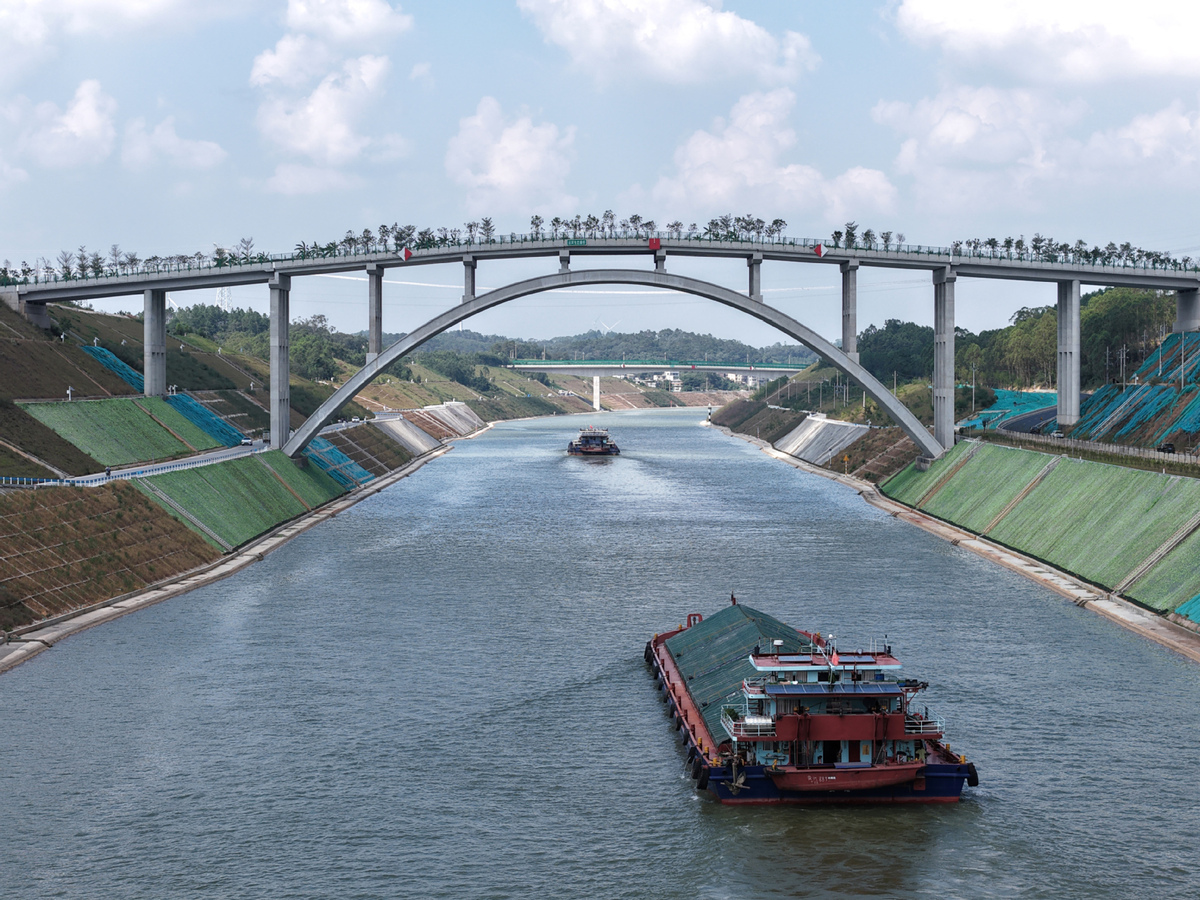
The opening of the 134.2-kilometre Pinglu Canal (平陆运河) in September 2026 marks more than the completion of one of China’s largest waterway projects. By providing a direct river-to-sea link between the Xijiang River system in Guangxi and the Beibu Gulf, the canal offers an alternative to established transport corridors through the Pearl River Delta. Its significance lies not simply in shortening transport distances, but in redistributing trade flows, strengthening Beibu Gulf’s position in China’s transport network and integrating inland production more closely with international markets, particularly with Southeast Asia. Pinglu thus represents a strategic attempt to reorganise China’s southern economic geography, diversify its maritime access and strengthen the logistical foundations of its external trade.
Described as one of the 'projects of the century' (世纪工程), highlighting its national strategic relevance and built at a significant cost of RMB 72.7 billion, Pinglu Canal is the first major river-to-sea canal project of its scale to receive national-level coordination since 1949. While Southwestern China has a substantial industrial and agricultural base and sits close to Southeast Asian markets, its access to maritime trade has relied heavily on the Pearl River system and ports in Guangdong. Pinglu, as part of the New International Land-Sea Trade Corridor, cuts the maritime distance to the sea by more than 560 kilometres, potentially reducing logistics costs by around 18-30 per cent. The early operational figures highlight this potential. More than one million tonnes of cargo moved through the canal during its first month of operation, albeit with temporary subsidies and other incentives. Yet, beyond this immediate commercial relevance, the canal’s long-term strategic value will largely depend on its ability to stimulate regional industrial development, redirect trade towards alternative ports and generate sustained economic activity along the new corridor.
Benefits for Guangxi: Connectivity to Industrial Advantage
For Guangxi, Pinglu Canal presents an opportunity to capture greater economic value from its expanding trade networks. Despite its strategic location bordering Vietnam and facing the Beibu Gulf, Guangxi has struggled to translate its geographical advantages into industrial competitiveness. Pinglu could address this gap by reducing production-related logistics costs and strengthening connections between inland manufacturing centers and coastal ports.
Guangxi’s expanding trade and evolving industrial structure make the canal particularly consequential. In 2025, its foreign trade reached RMB 819.26 billion, including RMB 489.74 billion in exports. ASEAN accounted for over half of its total trade. Pinglu’s economic benefits for Guangxi will vary across industries. While its growing electronics, automobile and battery exports reflect its shift towards higher-value manufacturing, the canal’s comparative advantage lies in the low-cost transportation of heavy, bulk cargo, where freight expenses constitute a significant share of production costs. With metal ore imports reaching RMB 128.71 billion in 2025, improved waterway connectivity could reduce input costs for metal processing facilities and other transport-intensive industries. The canal’s capacity to accommodate up to 5,000-tonne vessels could also reduce the need for repeated cargo transfers, thereby lowering handling costs and improving transport efficiency.
More importantly, Pinglu could generate industrial activity beyond its immediate transport functions. At the Liujing Industrial Park near Nanning, Qinshi Group is developing a new-energy shipbuilding facility to leverage demand for canal-compatible vessels. This illustrates how expanded shipping activity could stimulate investment in shipbuilding, equipment manufacturing and related services. This development aligns with Guangxi’s proposed Pinglu Canal Economic Belt, which promotes a “canal + port + industry” model to expand port-based manufacturing and industrial activity along the waterway. The development of Liujing port district also aims to strengthen cargo-handling capacity and attract investment in new-energy vehicles, electronics and advanced equipment manufacturing. Guangxi’s 15th Five-Year Plan further prioritises petrochemicals, non-ferrous metals and paper manufacturing alongside port-linked industrial development. Improved connectivity could also allow Qinzhou and other coastal centres to expand processing capacity, which would generate demand for logistics, warehousing and specialised industrial services.
The canal could therefore strengthen Guangxi’s economy through two distinct channels: lowering operating costs for existing industries and creating new demand for manufacturing and industrial services. Together, these could support more diversified industrial growth and strengthen Guangxi’s competitiveness within China’s southern economy.
Redrawing Southwest China's Economic Geography
China's Ministry of Transport had earlier emphasised the need to upgrade the Xijiang shipping trunk route, strengthen interprovincial waterway connections including Yunnan, Guizhou and Guangxi, and improve coordination between inland ports and those along the Beibu Gulf. The Pinglu Canal is one such example of integrating China's inland waterway networks with its coastal shipping infrastructure. It aims to not only provide southwestern provinces with an alternative trade route but also to spur economic activity in the nearby region. The canal is creating incentives for the development of inland ports, business opportunities and providing employment to locals, creating opportunities for new logistics and industrial activity.
However, constructing an alternative waterway does not automatically redirect established trade flows. Its commercial viability depends on attracting sufficient freight from southwestern provinces and persuading businesses to shift from existing transport routes. Recognising this challenge, the Guangxi government organised cargo-matching meetings with businesses from Chongqing, Yunnan and other important canal sources like Baise, Guigang and Chongzuo to secure freight volumes before the canal's inauguration. The government also introduced several supportive measures to address market concerns, established a special working group and issued the “Work Plan for Organising Cargo Sources for the Pinglu Canal” (平陆运河货源组织工作方案) for the canal’s smooth and efficient operation. The initial shipments, consisting of automobile components originating in Chongqing and Sichuan and construction machinery from Hunan, indicated the potential of interprovincial transport and trade networks. This could allow the hinterland manufacturers greater access to maritime markets as well as increased economic activity around Beibu ports.
Moreover, the Pinglu Canal forms a part of China’s growing emphasis on expanding inland waterways, alongside projects such as the Yangtze-Huaihe Grand Canal and the proposed Zhejiang-Jiangxi-Guangdong Grand Canal project. Although the success of such projects will depend on geographical suitability, existing river networks and freight demand, the operational experience of the Pinglu Canal can provide significant lessons in coordinating cross-provincial cargo flows and linking port infrastructure with industrial development.
Alongside improving China's hinterland connectivity, the Pinglu Canal can encourage local inland enterprises to access international markets, which can further strengthen their global competitiveness. According to a 2025 research on the New International Land-Sea Trade Corridor, better transport connectivity increases the participation of inland manufacturing enterprises in international markets by 5.6 percent. In this context, the Pinglu Canal can play a pivotal role in reducing the coastal-inland economic disparity by improving access to international shipping routes.
China-ASEAN: Equal Gains?
The canal has also opened a new route to existing China-ASEAN trade networks. Its opening a day before the 23rd China-ASEAN Expo in Nanning underscored China's broader efforts to deepen regional trade integration. The Nanning-Can Tho shipping route via the Pinglu Canal facilitates the movement of Vietnamese agricultural products into Guangxi, and Chinese manufactured goods into Vietnam. The route also significantly cuts down the logistics costs for Thai goods such as computers, fruits and rubber products entering China. The cargo range moving through the canal is also expanding beyond traditional goods such as grain and construction materials to include speciality cement, pulp and minerals from inland provinces such as Yunnan, Guizhou and Sichuan. This demonstrates its potential for two-way trade and deeper supply chain integration.
However, greater connectivity does not necessarily translate into equal economic gains. While Southeast Asian exporters could benefit from improved access to China's inland markets, the same infrastructure may strengthen the competitiveness of Chinese exporters in ASEAN markets. Existing concerns in Thailand and Indonesia over the influx of Chinese imports and dumping highlight the existing challenges faced by Southeast Asian producers. By lowering transport costs, Pinglu could intensify this competition, especially in sectors where Chinese firms enjoy advantages in scale and pricing. Thus, it could, on one hand, deepen China-ASEAN economic integration, while on the other, may reinforce existing trade and manufacturing imbalances.
Ultimately, Pinglu Canal reflects China's attempt to overcome longstanding geographical constraints through strategic infrastructure development. Its significance extends beyond shortening shipping routes to strengthening inland production networks, supporting regional industries and expanding China's commercial reach into Southeast Asia. However, the canal's lasting impact will depend on whether lower logistics costs translate into sustained cargo demand, industrial investment and commercially competitive shipping services. Its success could demonstrate how targeted infrastructure investment can reshape China's domestic economic geography while strengthening its position within regional trade networks.
Image Credit: China Daily
Author
Omkar Bhole
Omkar Bhole is a Senior Research Associate at the Organisation for Research on China and Asia (ORCA). He has studied Chinese language up to HSK4 and completed Masters in China Studies from Somaiya University, Mumbai. He has previously worked as a Chinese language instructor in Mumbai and Pune. His research interests are India’s neighbourhood policy, China’s foreign policy in South Asia, economic transformation and current dynamics of Chinese economy and its domestic politics. He was previously associated with the Institute of Chinese Studies (ICS) and What China Reads. He has also presented papers at several conferences on China. Omkar is currently working on understanding China’s Digital Yuan initiative and its implications for the South Asian region including India. He can be reached at [email protected] and @bhole_omkar on Twitter.
Arushi Sharma
Arushi Sharma is a Junior Research Associate at Organisation for Research on China and Asia (ORCA). She is a recent postgraduate in East Asian Studies from the University of Delhi and holds a Bachelor's degree in Chinese Language from K.R. Mangalam University. She has previously worked as a Subject Matter Expert in Mandarin Language at Unacademy. Her primary research interests focus on China's domestic politics and international economic statecraft.