
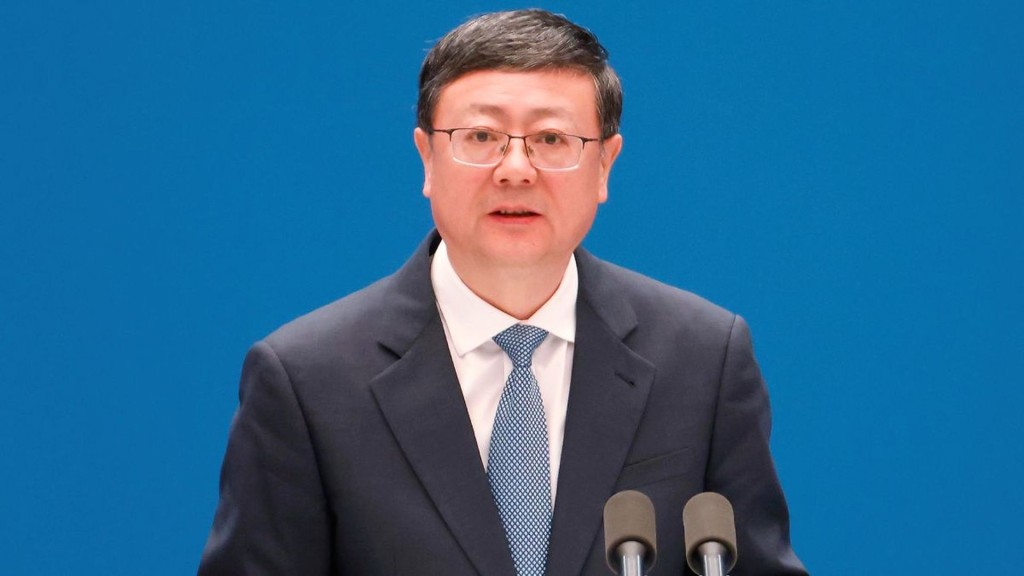
The announcement of an investigation into Shanghai’s Party Secretary and Politburo member, Chen Jining, is by far one of the most significant shakeups of Chinese politics in 2026. The Central Commission for Discipline Investigation’s (CCDI) decision to investigate Chen’s “serious violations of discipline and laws” is a near-confirmation of his purge, and effectively precludes his political elevation at the 21st National Party Congress (NPC). Considered a shoe-in for a Politburo Standing Committee seat by some, and at least a promising candidate by others, Chen’s downfall forces a recalibration of expectations for the 21st NPC in 2027.
After nearly 14 years of an ever-intensifying anti-corruption campaign, the only certainty is that the campaign and political struggles within the Communist Party of China (CPC) will surprise even the most keen-eyed observer as well as any well-reasoned conservative predictions of Chinese politics. The purge of Central Military Commission (CMC) members Zhang Youxia and Liu Zhenli earlier this year, too, was a lesson in coming to terms with the unpredictable. Chen’s investigation is a cliffhanger that leaves us scrambling to answer the why, what next and who next.
Explaining the Fall
Why Chen Jining may have been investigated is an open question with no verifiable answers. Perhaps his investigation, announced after the recently-concluded Fifth plenum, suggests he ran afoul of the political discipline criteria that Xi Jinping Thought on Party Building (习近平总书记关于党的建设的重要思想) has sought to promote? Or, was it a violation of the “correct view of performance” (正确政绩观); a failure to implement the Central Committee’s decisions or obey Xi Jinping’s directives?
With loyalty and performance defined amorphously, and political disciple constructed in terms of virtue, morality and character, one likely explanation is that Chen failed to sufficiently signal his compliance with standards of discipline or loyalty expected of cadres. The power of this explanation rests on the subjective, cognitive evaluation of loyalty and political discipline by Xi Jinping; a test any official in China could fail on any day. What matters is that Chen’s socialisation as a scientist and relatively-limited administrative experience, which would classify him a technocrat with narrow functional expertise, means he perhaps lacked the political nous of more-seasoned politicians in China, adept at navigating the vagaries of Chinese politics under Xi. Chen’s limitations as a political operator in a demanding environment could have made him an easy target to bring down.
Another possible explanation is that Chen may be the latest domino to fall in the rumoured-purge of the “Tsinghua clique”, with Chen Xi, a close associate of Xi Jinping and former head of the Organisation Department, at its centre. Chen Jining worked directly under Chen Xi at Tsinghua University for more than two years as Vice President when Chen Xi was Party Secretary of the University. Under Chen Xi, Chen Jining rose from the position of Vice-President to Secretary General of the University, and went on to become President of the University later on, from 2012 to 2015. Chen Jining’s rise coincides with Chen Xi’s tenure as head of the Organisation Department. Furthermore, several Chen Xi-associates like Zhang Jianchun (deputy minister of the Organization Department under Chen Xi), Wei Xiaodong (head of Beijing’s Organization Department during Chen Xi's tenure as head of the Organization Department) and Xia Linmao (Standing Committee member of the Beijing Municipal Committee) have been purged over the last year, fuelling speculation that Chen Xi’s network has been targeted for forming cliques. If it is indeed the case that the “Tsinghua clique” is being targeted, many more officials can be expected to fall in the coming months –including potentially Chen Xi himself.
A third likely explanation is that in any anti-corruption investigation, economic forms of corruption or performance failures cannot be ruled out. Shanghai is a “nest” of business and political interests, loaded with opportunity and risk. As its Party Secretary, Chen’s was entrusted with mobilising a variety of entrenched, local interests in the service of national goals. A large part of the task was to support the development of China’s AI industry, and a failure to deliver on this front would rest at Chen’s doorstep. A recent municipal audit investigation into science and technology financing in Shanghai found several shortcomings in policy execution. Another sign that underperformance could have been the culprit is a 25th November article in the Central Party School’s official mouthpiece, Study Times, on the “blind expansion of (strategic) industries”, a sign that Chen’s AI policy execution in Shanghai perhaps had a role to play in his downfall.
The abrupt manner of Chen’s investigation also indicates that the case against him may be definitive. For instance, Ma Xingrui, another technocrat and Politburo member who was purged recently, was first removed as Xinjiang’s Party Secretary, went missing from public view, after which the announcement of his investigation was made public. The gestation period of Ma’s case suggested a prolonged investigation into Ma’s financial wrongdoings. Chen’s case presents differently; the relatively-sudden announcement may represent a reckoning with performance failures. By this logic, it can be understood why Chen was active in the build-up to the announcement of the investigation, not missing from public view for long periods of time and has not been removed from office yet.
Furthermore, an expanded meeting of the Shanghai Party Committee on the day of Chen’s investigation announcement proclaimed its full support for the decision to investigate him, a sign that Shanghai cadres have been asked to close ranks, further reinforcing the perception of a definitive downfall.
What to Expect Next?
The question on everyone’s mind is who succeeds Chen Jining, or what happens next to Shanghai’s leadership. One possibility is that Zhu Zhongming, the Mayor of Shanghai, takes up the position eventually. Zhu has a banking and finance background which is ideal for Shanghai, previous administrative experience in other provinces and has been in Shanghai since 2024. Moreover, Zhu is a 70-s generation leader and will be 55 by the time of the 21st Party Congress in 2027, just a few years younger than Chen was when he was appointed to the Politburo in 2022. There is precedence for such a deduction: when Chen Liangyu, the last Party Secretary of Shanghai to be purged, was removed in 2006, the Mayor, Han Zheng, China’s current Vice President, was appointed Acting head before Xi Jinping took over as Party Secretary.
Another widely-expected scenario is the appointment of a relatively-more senior provincial leader, brought in from another province, who is trusted by the Party to stabilise the situation and signal order and normalcy to Party leadership in Shanghai. With reshuffles of provincial leaderships in August, September and October, and several former provincial party secretaries moved into National People’s Congress Commissions, the candidate list for this scenario is rather long. A third scenario, as outlined by acclaimed Taiwanese Sinologist Chien-wen Kou, is the appointment of a candidate from the central government or central party organs to serve concurrently as Shanghai Party Secretary.
Chen is the fourth Politburo member to be removed from office and his fall reiterates that the anti-corruption campaign will not waver for technocrats, loyalists or allies. With yet another promising, qualified and well-positioned candidate out of the Politburo picture, leadership turnover at the 21st Party Congress will be shaped by the ability to signal the correct political character, demonstrate unwavering compliance and appear unthreatening without being incompetent.
However Chen’s situation plays out, one thing is for certain; his fall has eliminated the far-fetched possibility that he was a potential successor to Xi Jinping. With many potential successors falling out of favour in recent years, Chen’s fall brings greater certainty to the argument that Xi Jinping will continue as General Secretary at the 21st Party Congress, and more importantly, is not preoccupied with succession just yet.
Image Credit: The Standard
Author
Rahul Karan Reddy
Rahul Karan Reddy is Senior Research Associate at Organisation for Research on China and Asia (ORCA). He works on domestic Chinese politics and trade, producing data-driven research in the form of reports, dashboards and digital media. He is the author of ‘Islands on the Rocks’, a monograph on the Senkaku/Diaoyu island dispute between China and Japan. He is the creator of the India-China Trade dashboard, the Chinese Provincial Development Indicators dashboard and co-lead for the project ‘Episodes of India-China Exchanges: Modern Bridges and Resonant Connections’. He is co-convenor of ORCA’s annual conference, the Global Conference on New Sinology (GCNS) and co-editor of ORCA’s daily newsletter, Conversations in Chinese Media (CiCM). He was previously a Research Analyst at the Chennai Center for China Studies (C3S), working on China’s foreign policy and domestic politics. His work has been published in The Diplomat, 9 Dash Line, East Asia Forum, ISDP & Tokyo Review, among others. He is also the Director of ORCA Consultancy.