
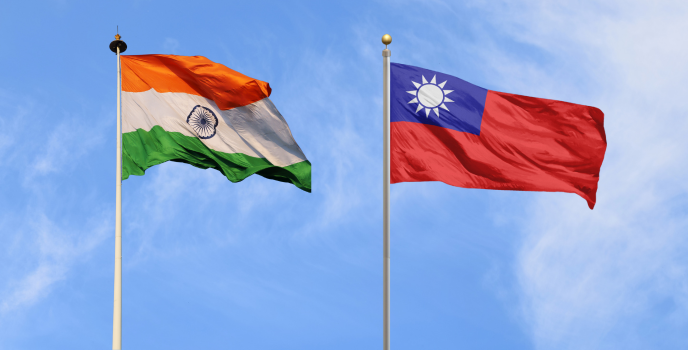
In January 2026, the signing of the Talented Labor Agreement between Taipei Economic and Cultural Center (TECC) and the Mizoram government signals that the India-Taiwan partnership has moved beyond mere economic rhetoric into deep structural integration. Historically, New Delhi’s engagement with Taipei was a cautious balancing act, often hamstrung by India’s territorial sensitivities with Beijing and a reactive cross-strait policy.
However, what was once a cautious and largely commercial relationship is evolving into a structured partnership spanning technology, labor mobility, education and supply chains, widening India’s strategic bandwidth. By strategically converging India’s Act East Policy (AEP) with Taiwan’s New Southbound Policy (NSP), India increasingly views Taiwan as a capability provider that can support domestic industrial transformation and reduce exposure to geopolitical supply shocks. The complementarity between Taiwan’s technological expertise and India’s market scale supports the emergence of a more resilient regional economic structure which is less susceptible to China’s supply chain dominance. Thus, India’s Taiwan policy is no longer purely derivative of its China calculus; it is increasingly shaped by technological security, supply chain resilience and the strategic posturing in Indo-Pacific geopolitics.
Strategic Synergy Without Formal Alignment
The establishment of the third Taipei Economic and Cultural Center (TECC) in Mumbai in 2024 exemplifies a carefully calibrated expansion of engagement despite Beijing’s sensitivities vis-a-vis Taiwan. India has consistently argued that its policy on Taiwan is “clear and consistent”. This stance implies that while India maintains its existing diplomatic framework, it deliberately refrains from reiterating the “One China policy” in official bilateral statements, a practice maintained since 2010. New Delhi asserts strategic autonomy, unitizing functional cooperation to reduce strategic vulnerability.
Similarly, several track dialogues between India and Taiwan aim to normalize Taiwan’s participation in non-sensitive strategic domains without crossing the threshold of formal security cooperation. Such dialogues aim to address broader Indo-Pacific challenges, focusing on maritime governance, cybersecurity and supply chain resilience. From an Indo-Pacific perspective, these dialogues support Taiwan’s role as a de facto economic partner and a functional stakeholder. By fostering cooperation in non-sensitive but strategically vital domains, it allows regional actors to build a resilient, rules-based order that safeguards maritime commons and high-tech ecosystems without the immediate need for formal diplomatic realignments.
Crucially, the trajectory of this partnership is also partly dictated by Taiwan’s domestic political landscape as DPP’s outward-looking orientation has removed historical territorial baggage that once hindered KMT-India ties. This shift has transformed Taiwan from a sensitive diplomatic liability into a pivotal pragmatic partner. For New Delhi, the current DPP administration offers a strategic alignment that serves India’s interest in regional power balancing, effectively integrating Taiwan into India’s broader Indo-Pacific architecture as part of a broader efforts to diversify India’s strategic choices in the Indo-Pacific. Furthermore, Taiwan’s New Southbound Policy finds a natural strategic synergy with India’s Act East Policy. While these policies are not formally coordinated strategies, their parallel evolution has created a framework for pragmatic convergence.
Besides the Act East Policy’s traditional focus on Southeast Asia, today it has evolved into a comprehensive framework that increasingly overlaps Taiwan’s NSP. This convergence enables deeper sectoral cooperation, allowing New Delhi to leverage Taiwan’s strengths to bolster its regional influence without the need for explicit political alignment. Its broader Indo-Pacific goals increasingly find a functional partner in Taiwan, particularly in securing high-tech supply chains and maritime stability. Conversely, India provides the strategic depth and labor resources essential for Taiwan’s de-risking strategy away from the PRC. By aligning these two policies, New Delhi and Taipei are moving beyond traditional diplomacy towards a functional partnership that gradually reshapes patterns of economic cooperation in the Indo-Pacific.
Importantly, this approach implies selective engagements rather than ideological alignment. New Delhi has shown little interest in framing ties with Taiwan through bloc politics. Instead, cooperation framework has been calibrated to maximize economic and technological gains while preserving diplomatic flexibility. By adopting this strategy, New Delhi does not challenge the diplomatic status quo, but it is steadily normalizing Taiwan’s role within its Indo-Pacific strategy. Such recalibration also aligns with India’s commitment to strategic autonomy—expanding substantive engagement while preserving diplomatic flexibility. This has resulted in a form of partnership that has enhanced India’s Indo-Pacific positioning without crossing escalation thresholds with Beijing.
Practical Partnership: From Semiconductor Autonomy to Regional Clusters
The semiconductor sector provides the clearest window into India’s evolving strategic logic. India aims to expand its ties with Taiwan through the India Semiconductor Mission, fostering a strategic rear for Taiwan and tech autonomy for India. In 2024, Tata Electronics and Powerchip Semiconductor Manufacturing Corporation (力積電, PSMC) signed an Agreement to build the first 12-inch wafer factory in India, and transferring mature process technologies and training the Indian workforce. Rather than formal advocacy, India has pursued functional inclusion, integrating Taiwan into IPEF-related supply chain dialogues and security forums. This move has allowed New Delhi to bolster its industrial resilience and reduce critical technology dependencies without diplomatic overreach. This pragmatic engagement effectively leverages Taiwan’s expertise to fuel India’s Make in India ambitions while preserving its strategic autonomy.
Apart from cooperation in the technology sector, bilateral trade between India and Taiwan has doubled since 2018, crossing $10 billion and signaling a transition from exploratory commerce to structured economic interdependence. For the current year, trade from January to October 2025 has already reached to 10.1 billion, a 17.69% increase compared to the 8.58 billion recorded during the same period in 2024. Over 260 Taiwanese companies that have investments in India are strategically distributed across regional clusters, ranging from automotive and appliances in the North (Gujarat and Noida) to electronics, aerospace, and textiles in the South and West. Taiwan has emerged as a pivotal technology provider for India, aligning with New Delhi’s “Viksit Bharat at 2047” vision to become a developed country.
More broadly, India has pursued Taiwan’s inclusion in supply chain dialogues and mechanisms such as the Indo-Pacific Economic Framework without elevating the relationship into a formal strategic partnership. This has allowed New Delhi to gain technological benefits while keeping escalation risks manageable. The same logic is visible in emerging sectors such as drones and precision machinery. The drone industry serves as a prime example: New Delhi’s restrictions on Chinese-made drones and components due to cybersecurity concerns has created a strategic space for Taiwan. Taiwan’s drone technology now offers significant value across military and agricultural sectors, with a projected market value of 11million dollars.
From Taiwan’s perspective, India’s vast population provides a critical labor resource, especially as Taiwan navigates the challenges of a low birth rate and an ageing population. In 2024, India and Taiwan have signed an MOU on labor mobility as Taiwan plans to recruit workers primarily from India’s Northeast states, potentially facilitating smoother integration compared to other regions.
Similarly, Taiwanese firms increasingly export not just hardware but production expertise, supporting India’s attempt to upgrade its manufacturing base. This transition from transactional trade to capability transfer marks a qualitative shift in the relationship. Taiwan’s exports of high-end machine tools and industrial infrastructure are crucial for India’s local manufacturing. From January to September in 2025, the volume of exporting high-end machine is 105 million. The growing emphasis on “talent localization”, particularly around hubs such as Chennai, further reinforces supply-chain resilience. Taiwanese managerial practices combined with India’s demographic advantage create a production model that can create a win-win situation for both sides.
Structural Constraints on Convergence
India’s approach to Taiwan in the Indo-Pacific context is best understood as a cautious, interest-driven, and strategically calibrated engagement rather than a value-based or alliance-oriented policy. While New Delhi does not challenge the One China Policy at the diplomatic level, it has consistently sought to expand substantive and functional cooperation with Taiwan in areas such as trade, education, technology and people-to-people exchanges.
At the same time, India’s room for maneuver remains shaped by the broader challenges which can limit strategic convergence. First, geopolitical sensitivity surrounding Beijing still shapes the ceiling of engagement. Periods of heightened tensions with China tend to widen space for Taiwan–India engagement, whereas moments of cross-strait rapprochement constrain it. Thus, India must continuously calibrate its engagement to expand functional cooperation without triggering a definitive diplomatic crisis. Second, bureaucratic inertia, regulatory complexity and cultural gaps may slow project implementation, particularly in semiconductor cooperation which require long gestation periods and policy consistency.
This steady and cautious approach favors long-term economic security over symbolic gestures, ensuring the partnership remains resilient against external pressure while meeting practical Indo-Pacific needs. Third, the absence of security guarantees underscores the relationship’s pragmatic nature. From Delhi’s perspective, the partnership is designed for resilience—not deterrence. Recognizing these constraints is essential to understanding why India favours gradual expansion in high-impact but relatively low-visibility sectors.
Overall, India’s Taiwan policy under the Indo-Pacific framework can be characterized as a form of selective and functional engagement. It has created strategic ambiguity to expand cooperation without crossing the threshold of direct provocation. This approach is likely to continue, with future growth concentrated in non-sensitive domains such as high technology, industrial collaboration, education and labor mobility, rather than formal diplomatic ties. The future of India–Taiwan relations will therefore depend less on symbolic gestures and more on technological interdependence. As supply chains increasingly become instruments of geopolitical competition, India-Taiwan partnership, which is built on capability transfer, may quietly reshape regional alignments in the contested Indo-Pacific region.
Author
Chieh-Ju Chen
Chieh-Ju Chen (Nikita) is a Research Intern at Organisation for Research on China and Asia (ORCA). Currently, she is an MA student at the Graduate Institute of International Politics, National Chung Hsing University (NCHU), Taiwan. Her research focuses on refugee and immigration studies, with interests in South Asia and Indian studies, and a comparative perspective on regional dynamics in Asia.