
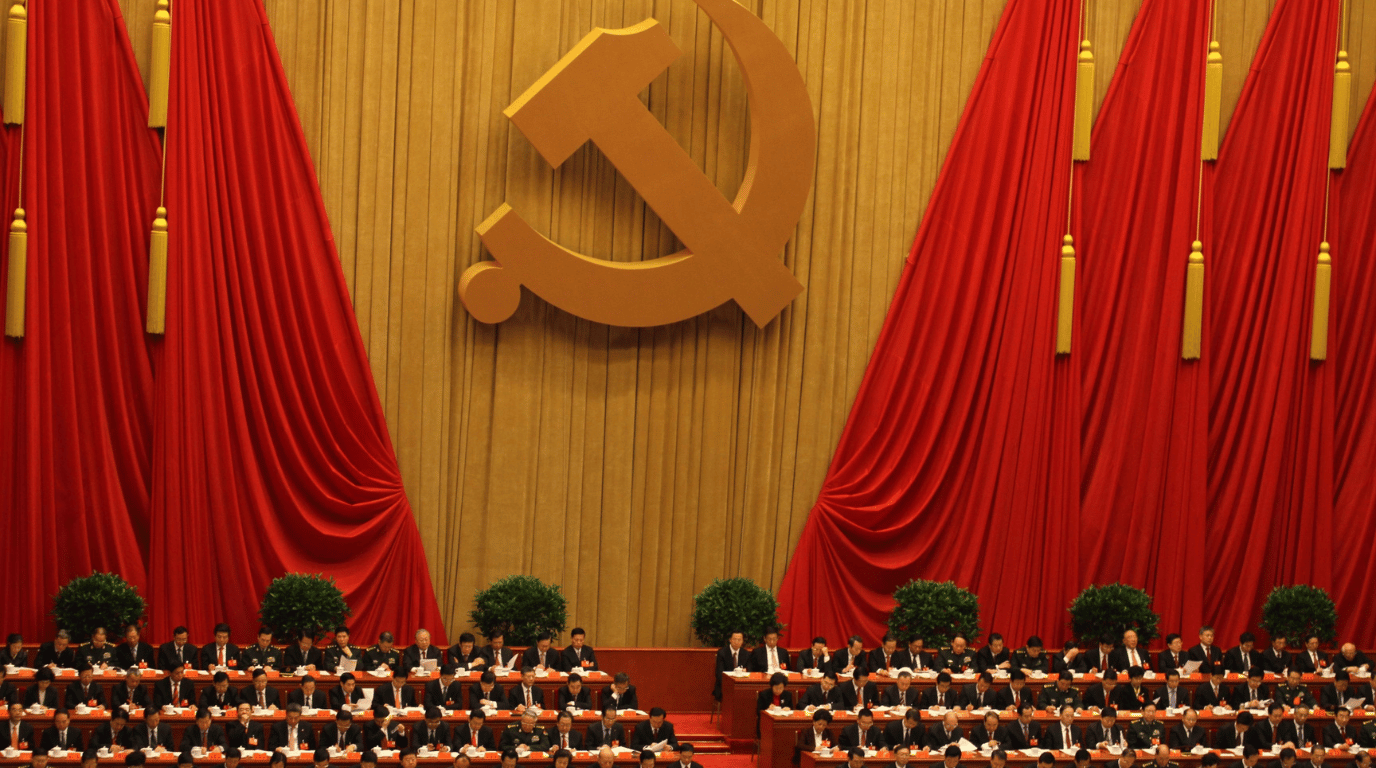
The days following the Communist Party of China’s (CPC) 5th Plenum have seen the Party-State machinery spring into high-gear. Driven by fear or loyalty, party and state organs have moved quickly to signal their commitment to follow through on the Plenum’s Decision on Several Major Issues Concerning Persistently Advancing the Comprehensive and Strict Governance of the Party (中共中央关于持之以恒推进全面从严治党若干重大问题的决定). The mobilising effect attests to the significance of announcements and outcomes at the Plenum. More importantly, it certifies the notion that Xi Jinping rules the CPC unchallenged; a condition that ensures decisions at the 21st Party Congress, expected or otherwise, are accepted readily by the Party.
Unsurprisingly, the 5th Plenum had observers of Chinese politics fix their attention on the large number of purged or missing officials. With 97 Central Committee (CC) members absent, the promotion of Zhang Shengmin to the Politburo and 10 alternate members promoted to Full CC membership, personnel management outcomes were an unmissable highlight of the Plenum. Equally importantly though, it was an exercise in political manoeuvring, one that combined the consolidation of authority with long-term planning for the governance of the Party. It was a rigorous justification of the political trajectory set by Xi Jinping to answer the Yan’an cave-dwelling question of regime survival through supervision and self-revolution (党的自我革命).
The Planned and Purged
Like previous political gatherings in Xi Jinping’s third term, the 5th Plenum was a shake-up of the established order. The agenda of this Plenum was Party building, which is typically a focus of the 6th Plenum. The shuffled political calendar reflects the primacy accorded to ideology and “correct” development of the Party. A more striking departure from convention at this Plenum was the number of CC members present; the 20th CC in 2022 began with 376 members in total, the first Plenum had 203 Full members and 168 alternate ones, the fourth plenum held last year involved 168 Full and 147 Alternate ones, which decreased to 162 Full and 117 Alternate members, just 279 of the original 376 in 2022. A turnout of 79% ranks this Plenum the lowest in terms of attendance in decades, and is a reminder of the sword that hangs over the head of CC members. The 5th Plenum confirmed the long-anticipated removal of 33 CC members, like Ma Xingrui, Jin Zhuanglong and Liu Jianchao, of which 16 were from the military, like Zhang Youxia and Liu Zhenli.
Furthermore, there appears to be no urgency to fill the growing vacancies, as only 10 Alternate members were promoted to the CC, like Bao Gang, Liu Qiang (who we predicted would become a Full CC member) and Liu Jie. Zhang Shengmin’s promotion to the Politburo was no surprise, given his instrumental significance in managing the disciplinary apparatus within the military; he is almost certain to retain a Politburo seat at the 21st Party Congress. The staggered pace of appointments to the CC indicates a reluctance to make personnel appointments during periods of churn and uncertainty.
Consequently, appointments in the year ahead will likely be characterised by two features; one, track records that indicate an ability to faithfully, and competently, executive central directives relating to the 15th FYP, and two, inductions of the 1970s generation cohort while ensuring political stability after the 21st Party Congress. The Decision document adopted at the Plenum clearly states that in matters of personnel selection, the moral character (redness) of candidates will be prioritised over competence, indicating a preference for stability and loyalty.
Party Building, Personal Authority and Performance
The Decision on Advancing the Comprehensive and Strict Governance of the Party adopted at the Plenum reveals how the need for regime security is articulated alongside an effort to enhance Xi Jinping’s position in the run-up to the Party Congress. These twin objectives are attained by praising the magnitude of Xi’s contributions to Party building and contrasting them to the Party’s condition prior to Xi Jinping, which is described as dire. Against that backdrop, Xi’s contributions and Xi Jinping Thought (习近平思想) are framed as answers to the question of how to break the historical cycle of rise and fall of regimes. While the Plenum rather unsurprisingly discussed external risks facing China, it also interestingly mentioned internal challenges emanating from a generational shift within the Party, corrupt officials, difficulty of educating younger cadres and residual problems of work styles and impure conduct. The internal and external challenges are evident rationalisations for simultaneously advancing strict governance of the Party and elevating the authority of Xi Jinping.
Without doubt, Xi’s position is being reinforced in the build-up to the Party Congress by the Plenum document, which lays down the acceptable parameters of political behaviour in the name of supervision and discipline. The Decision warns cadres against challenging the centralisation of power by maintaining that the Party will not tolerate formation of cliques, disobedience, buying and selling of offices, and allow powerful figures to become uncontrollable and criticize the central leadership. Reiterating this in the year leading up to the Party Congress neutralises any challenge to Xi Jinping’s power. The role of political education has also been highlighted for a similar, centralising purpose; to unify the thinking of officials with the Party centre’s judgement of situations, decisions and actions. Following the Plenum, we are likely to witness enhanced supervision of financial activity, social relations and moral character of officials, to habituate them to work in an environment of constant supervision and prevent unexpected political risks. The normalisation and exaltation of an atmosphere of heightened scrutiny has mixed impacts on policy outcomes, but certainly strengthens Xi’s governing position.
Plenum documents also reiterate the importance of securing the compliance of officials in executing the decisions of the Party centre. Improvements in the supervision of officials to ensure implementation of decisions and prompt identification of ineffective execution are expected to increase in the year ahead. For instance, in terms of work style (工作作风), although problems of hedonism and extravagance are considered to be largely dealt with, problems of formalism and bureaucracy – issues relating to decision implementation and policy execution – are still considered a challenge. Promoting the correct view of performance is another ideological vehicle through which securing the compliance of all Party officials has been articulated. Zhang Shengmin’s promotion is a fine example of how the correct view of performance (正确政绩观) (Xi’s view), where execution of Xi’s disciplinary campaign in a challenging domain, has been rewarded with elevation. On the other hand, the correct view of performance is a dynamic condition, with the Plenum promising that the criteria to evaluate performance will be constantly updated.
What Comes Next
The concluded Plenum has demonstrated that Party construction and political culture will be priorities for Xi in the period before and after the Party Congress. The emphasis on supervision and discipline, enforced through the anti-corruption campaign and political education are likely to intensify or at least continue unabated. With political development leading the line, policy planning in the economic and social domain is highly likely to emphasise management of political risk, ensure continuity of implementation and attribute any achievements to Xi Jinping and his governing philosophy. The 5th Plenum has made Party building synonymous with enshrining Xi’s personal authority and place in China’s political landscape and long-term development. As the Party approaches the Congress in 2027, calls for greater political discipline, self-revolution and heightened scrutiny of compliance with central directives will become sharper, setting the stage for Xi’s fourth term as General Secretary.
Author
Rahul Karan Reddy
Rahul Karan Reddy is Senior Research Associate at Organisation for Research on China and Asia (ORCA). He works on domestic Chinese politics and trade, producing data-driven research in the form of reports, dashboards and digital media. He is the author of ‘Islands on the Rocks’, a monograph on the Senkaku/Diaoyu island dispute between China and Japan. He is the creator of the India-China Trade dashboard, the Chinese Provincial Development Indicators dashboard and co-lead for the project ‘Episodes of India-China Exchanges: Modern Bridges and Resonant Connections’. He is co-convenor of ORCA’s annual conference, the Global Conference on New Sinology (GCNS) and co-editor of ORCA’s daily newsletter, Conversations in Chinese Media (CiCM). He was previously a Research Analyst at the Chennai Center for China Studies (C3S), working on China’s foreign policy and domestic politics. His work has been published in The Diplomat, 9 Dash Line, East Asia Forum, ISDP & Tokyo Review, among others. He is also the Director of ORCA Consultancy.